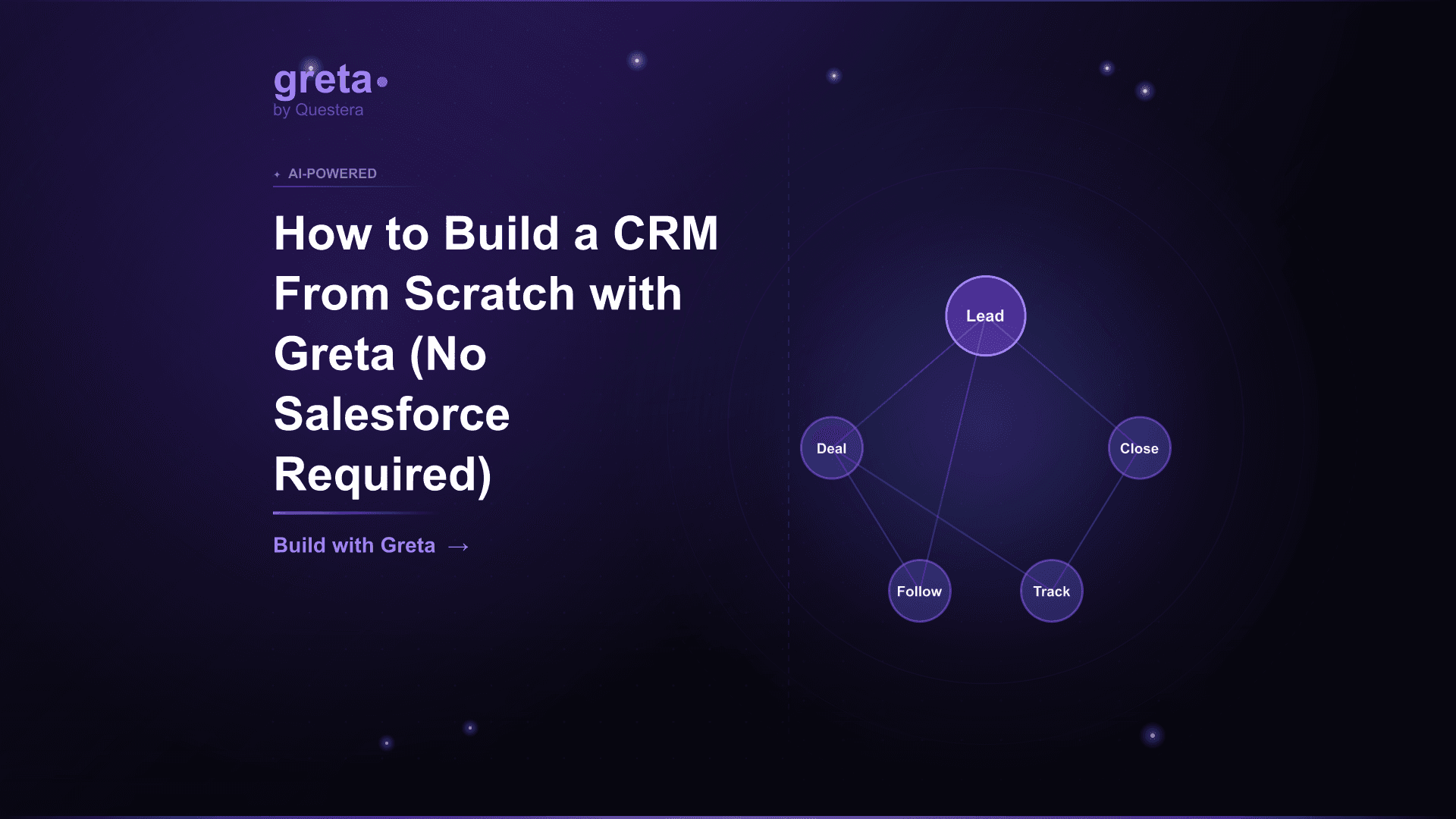
TL;DR: Salesforce, HubSpot, Pipedrive, and other established CRMs are powerful but generic. They work for most teams; they work brilliantly for none. The 2026 alternative for solo founders and small teams: build your own niche-fit CRM with Greta.sh in 1--2 days. The build covers contacts, companies, deals, activities, custom fields, email sync, and the niche-specific workflow that no off-the-shelf CRM handles cleanly. This guide covers the exact build sequence, data model, automation patterns, and the migration path from spreadsheet or generic CRM. The result: a CRM that actually fits your workflow instead of forcing your workflow to fit the CRM.
Introduction
Most CRM users only use 10--20% of what their CRM does. The other 80% is generic features built for sales teams at companies with very different workflows than theirs. Solo consultants pay $50/user/month for features designed for 50-person sales orgs. Indie agency founders shoehorn their projects into 'deals' and 'opportunities' that don't match how they actually work. The pattern is consistent: powerful generic CRMs serving everyone moderately well and no one specifically well.
The 2026 alternative for solo founders and small teams: build the CRM that fits your exact workflow. With Greta.sh, a tight 1--2 day build produces a niche-fit CRM with contacts, companies, deals, activities, email sync, and the specific workflows your business actually runs on. The cost is your time; the result is a CRM that compounds value the longer you use it.
Why build instead of buy?
Honest framing: building isn't always the right answer. Sometimes Salesforce or HubSpot is the right pick.
When to build
- Your workflow doesn't match generic 'deals' and 'opportunities' models
- You only need 20% of what a generic CRM offers but pay for 100%
- Specific automations matter that generic CRMs make hard
- Data sovereignty matters (own the database, control the data)
- You're a solo founder or small team where per-user pricing dominates the math
- You want CRM features in places generic CRMs don't reach (embedded in your product, customer portal)
- Niche-specific data fields and relationships that don't map cleanly to standard CRM schemas
When to buy
- You need enterprise features (advanced security, complex permission roles, audit logs, compliance certifications)
- Your team is already on a generic CRM and migration cost outweighs benefit
- You need deep marketplace integrations (Slack, Gmail, Zoom, hundreds of others)
- You want vendor support and accountability
- Your team is large enough that per-user pricing is justified by value
- Your workflow IS generic and standard CRMs fit it well
For solo founders, indie agencies, and small teams with specific workflows, the build option is increasingly viable. For larger teams or generic workflows, buy still wins.
The CRM data model
The core data model that covers most CRM use cases.
| Entity | Key Fields | Relationships |
|---|---|---|
| Contact | Name, Email, Phone, Title, Tags, Notes | Belongs to Company; has many Activities, Deals |
| Company | Name, Website, Industry, Size, Notes, Custom Fields | Has many Contacts, Deals, Activities |
| Deal | Name, Value, Stage, Close Date, Owner, Notes | Belongs to Company; assigned to User; has many Activities |
| Activity | Type, Subject, Date, Owner, Outcome, Notes | Belongs to Contact or Company or Deal |
| Pipeline | Name, Stages (array) | Has many Deals |
| Task | Title, Due Date, Owner, Status, Related To | Assigned to User; related to entity |
| Note | Body, Created At, Author, Related To | Belongs to Contact or Company or Deal |
| Tag | Name, Color | Many-to-many with Contact, Company, Deal |
Most CRMs are variations on this core. Niche-specific CRMs add custom fields and entities specific to the workflow --- Matter for solo lawyers, Property for real estate agents, Project for consultants.
Got an idea? Build it now!
Just start with a simple prompt. No coding required: Greta.sh turns your idea into a working app in minutes.
The 1--2 day build sequence
Day 1, hours 1--2: Spec and scaffold
- Write the 1-page PRD: business type, workflow specifics, key entities, custom fields, niche differentiators
- Scaffolding prompt: "Build a CRM for [specific business type]. Core entities: Contacts, Companies, Deals, Activities, Tasks. Auth via magic link. Multi-user with team support."
- Apply design vibe --- most CRMs work well with clean, professional, data-dense layouts
- Data model implementation: tables for each entity with the fields above plus niche-specific custom fields
Day 1, hours 3--5: Contacts and companies
- Build the contacts list view with search, filter (by tag, company, owner, last contacted), and sort
- Add contact detail page with activities timeline, related deals, related companies, notes
- Build the companies list and detail pages with related contacts, deals, activities
- Add inline editing for fast updates
- Bulk operations: bulk tag, bulk assign, bulk export
Day 1, hours 6--8: Deals and pipelines
- Build pipeline view --- kanban-style with stages as columns and deals as draggable cards
- Add deal detail page with related contacts, activities, value, expected close date, owner
- Build the deal list view alternative with filters and sorts
- Add pipeline configuration --- create custom pipelines with custom stages for different workflow types
- Add deal won/lost tracking with reasons
Day 2, hours 1--3: Activities and tasks
- Build activity logging --- quick log a call, email, meeting, or note from any contact/company/deal
- Add activity types specific to your workflow (consultation call, contract sent, demo, follow-up)
- Build tasks linked to contacts/companies/deals with due dates and assignees
- Add the today view showing today's tasks, overdue tasks, and upcoming follow-ups
- Add email reminders for upcoming tasks
Day 2, hours 4--6: Email sync and integrations
- Email integration --- connect Gmail or Outlook via OAuth. Emails to/from CRM contacts auto-log as activities.
- Calendar integration --- meetings with CRM contacts auto-log to the activity timeline
- Stripe integration if relevant --- invoices and payments link to contacts and deals
- Custom webhook integrations --- events in your other tools create activities in the CRM
Day 2, hours 7--8: Niche-specific workflows and launch
- Add niche-specific custom fields (e.g., 'Match Score' for recruiting CRMs, 'Practice Area' for legal CRMs)
- Add niche-specific automations (e.g., new contact tagged 'Lead' auto-enrolls in a follow-up sequence)
- Polish: mobile responsive, empty states, search across everything
- If team CRM: invite teammates, configure permissions, test multi-user flows
- If SaaS for others: Stripe Subscriptions, pricing page, soft launch to 5--10 friendly customers
MCP and AI features that make the CRM smarter
Modern CRMs benefit from AI features that turn raw data into actionable insights. MCP (Model Context Protocol) is how to add them.
AI features that genuinely add value
- AI summary of a contact --- Pulling activities, notes, and emails into a 'here's what you need to know about this contact' summary
- AI-drafted follow-ups --- Generating personalized follow-up emails from contact context
- AI tagging --- Suggesting tags for new contacts based on company and role
- AI activity logging --- Recording calls/meetings and AI-generating the activity notes
- AI insights on deals --- Identifying deals that haven't moved in N days and suggesting next steps
AI features to skip
- AI lead scoring --- Hard to do well without historical conversion data; defer until you have it
- AI sales forecasting --- Sophisticated and noisy; not worth the build for solo or small teams
- AI conversation analysis --- Privacy concerns and marginal value for most use cases
- AI everything else --- Resist adding AI just to claim AI features; add only where it solves a real workflow problem
Automation patterns that compound
CRM automations save time and create consistency. The high-value automations:
- New contact created → Auto-assign to owner based on round-robin or territory rules
- Deal moves to 'Sent Proposal' stage → Auto-create follow-up task in 3 days
- Contact tagged 'Cold Lead' → Auto-enroll in 5-email nurture sequence
- No activity logged in 30 days → Send reminder to deal owner
- Deal won → Auto-send thank-you email + onboarding link
- Deal lost → Auto-schedule 90-day re-engagement task
- Email replied within X hours → Auto-log activity and notify deal owner
Got an idea? Build it now!
Just start with a simple prompt. No coding required: Greta.sh turns your idea into a working app in minutes.
Niche-specific CRM patterns
Solo consultants and freelancers
- Project entity instead of (or alongside) Deal
- Custom fields: rate, project type, scope, deliverables
- Time tracking integration (Harvest, Toggl)
- Invoice integration (Stripe, QuickBooks)
Indie agencies
- Multi-stage pipelines for different service types
- Resource allocation features (which team member is assigned to which client)
- Project profitability dashboards (revenue vs cost per client)
- Contract and SOW templates linked to deals
Solo professionals (lawyers, accountants, financial advisors)
- Matter or case entity for active engagements
- Document/file storage linked to contacts and matters
- Compliance fields specific to the profession
- Time tracking and billing integration
Indie sales for SaaS products
- MRR/ARR tracking on deals (not just one-time value)
- Customer health scoring
- Churn risk tracking
- Upsell/expansion pipeline separate from new business
Migration from spreadsheets or existing CRM
From spreadsheets
- Export the spreadsheet to CSV
- Build an import flow in your CRM that maps CSV columns to fields
- Run a test import with 10 records first
- Run the full import; verify data integrity
- Set up the spreadsheet-to-CRM workflow change for the team
From existing CRM (HubSpot, Pipedrive, Salesforce)
- Most CRMs allow CSV export of contacts, companies, deals, and activities
- Export each entity type separately
- Build import flows for each in your custom CRM
- Map custom fields carefully --- generic CRMs have specific field types that may need conversion
- Run parallel for 2--4 weeks before fully switching
- Verify reports and dashboards reproduce the metrics you cared about
Cost comparison
| CRM | Annual Cost (3-user team) | Notes |
|---|---|---|
| Salesforce Sales Cloud | ~$10,800/year | Enterprise features, deep customization |
| HubSpot Sales Pro | ~$5,400/year | Marketing automation included |
| Pipedrive Advanced | ~$1,750/year | Simpler, sales-focused |
| Custom CRM (Greta.sh) | Greta.sh subscription + build time | Bundled subscription; own the build |
For solo founders, the cost difference compounds. Generic CRM at $50--$200/user/month vs. Greta.sh subscription with your custom CRM as one of many things you've built. The math favors custom CRM the longer you use it.
Got an idea? Build it now!
Just start with a simple prompt. No coding required: Greta.sh turns your idea into a working app in minutes.
Common Mistakes Building Custom CRMs
- Over-building the v1 --- Generic CRMs have 500 features for a reason. Don't try to recreate all of them. Build your specific 20%.
- Skipping the niche-fit work --- Without niche-specific workflows, you've built a worse Pipedrive. Add the workflows that justify the build.
- Underestimating data import --- Migration from existing CRM is often the hardest part. Plan it carefully.
- Not building backup/export from day one --- Lock-in defeats the purpose. Ensure you can export everything anytime.
- Treating it as side project that lingers --- Either commit and ship in 1--2 days or use the generic CRM. Half-built CRMs are worse than no CRM.
- Skipping mobile responsive --- Salespeople use CRMs on phones during travel and meetings. Mobile UX matters.
- Adding features without validating use --- 'I might need this someday' adds complexity now and rarely pays off later.
- Ignoring email integration --- Email sync is the killer feature of CRMs. Build it well or skip the build.
- Skipping the team flow even if you're solo --- At some point you'll add a teammate; designing for multi-user from day one is easier than retrofitting.
Frequently Asked Questions
Q1: Can a non-developer really build a CRM in 1--2 days? Yes, for the core CRM (contacts, companies, deals, activities) with niche-specific workflows. The 1--2 day estimate assumes focused work; expect 2--4 days if you're learning the platform alongside the build.
Q2: Will my custom CRM be as good as Salesforce? No --- Salesforce has 25+ years of feature depth, ecosystem, and enterprise capability. Your custom CRM will be much better for your specific workflow but lack the breadth. For solo founders and small teams, the trade is worth it.
Q3: What about HubSpot's free CRM? HubSpot Free is genuinely good. Many founders use it as the starting point and migrate to custom CRM only when specific limitations bite. If HubSpot Free works for you, use it.
Q4: How do I handle email sync? OAuth into Gmail or Outlook; auto-log emails to/from CRM contacts as activities. Modern AI app builders support this; the prompt is "add Gmail email sync via OAuth that logs emails to/from CRM contacts as activities." Test on a personal account first.
Q5: What about reporting and dashboards? Build the specific dashboards you use weekly. Pipeline value by stage, deals won this month, activities per rep, conversion rate by source. Skip the dozens of generic reports that come standard in Salesforce and never get opened.
Q6: Can I sell this as a SaaS product? Yes --- vertical CRMs (CRMs specific to one industry) are a viable indie SaaS category. Solo founders building niche CRMs for specific industries (real estate, legal, financial advisory) have grown to meaningful revenue.
Q7: What about CRM AI features? Add the AI features that solve specific workflow problems: contact summary, follow-up drafts, activity dictation. Skip the AI features that don't have a clear use case. Most AI in CRMs is hype; the few features that work are workflow-specific.
Conclusion
- Generic CRMs (Salesforce, HubSpot, Pipedrive) are powerful but built for everyone. Custom CRMs built with Greta.sh in 1--2 days fit your specific workflow.
- Build when: workflow doesn't match generic CRM models, you only use 20% of generic CRM features, niche-specific automations matter, data sovereignty matters, per-user pricing is painful for solo/small teams.
- Buy when: you need enterprise features, deep marketplace integrations, vendor support, or your workflow IS generic.
- The build is 1--2 days for core CRM + niche-specific workflows. AI features add value where they solve specific workflow problems; skip them otherwise.
Write your 1-page CRM PRD this morning. Run through the 1--2 day build today and tomorrow. By the end of the week, you have a CRM that actually fits your workflow instead of fighting it. The cost is your time. The result is a CRM that compounds value the longer you use it --- and you stop paying $50--$200/user/month for features you don't use.