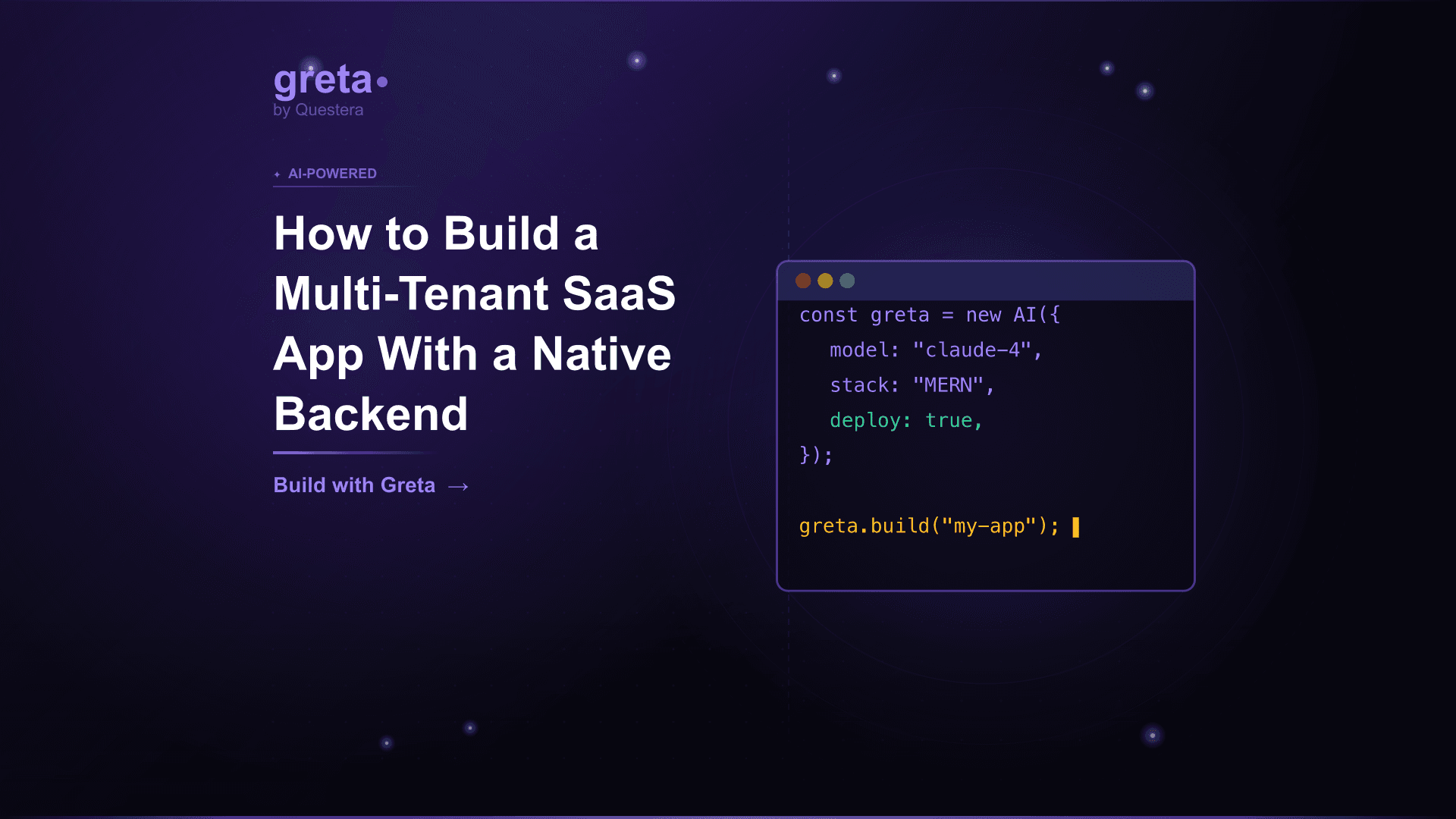
TL;DR: To build a multi-tenant SaaS app, you architect one application that serves many isolated customers (tenants) from a shared native backend. Each tenant's data is segregated, with shared auth and billing. AI builders can scaffold this --- tenant model, isolation, and roles --- from a clear description.
Introduction
Nearly every modern SaaS is multi-tenant --- one codebase serving thousands of separate customers. Getting the architecture right early is what lets a product scale without rewrites later. Get it wrong, and you inherit a data-isolation nightmare.
This guide explains how to build a multi-tenant SaaS app with a native backend in 2026 --- covering tenancy models, data isolation, auth, billing, and how AI builders accelerate the work.
What is a multi-tenant SaaS app?
A multi-tenant SaaS app is a single application instance that serves multiple customers --- called tenants --- while keeping each tenant's data and configuration isolated from the others.
Instead of running a separate copy per customer, you run one app with a tenant boundary baked into the data model. This is what makes SaaS economically scalable.
What are the main tenancy models?
There are three common approaches to isolating tenant data, each with trade-offs in cost, isolation, and complexity.
| Model | How it works | Best for |
|---|---|---|
| Shared DB, shared schema | Tenant ID column on every table | Cost-efficient, most SaaS |
| Shared DB, separate schema | One schema per tenant | Stronger isolation, mid-scale |
| Separate database per tenant | One DB per tenant | High-compliance, enterprise |
Got an idea? Build it now!
Just start with a simple prompt. No coding required — Greta.sh turns your idea into a working app in minutes.
What does a native backend give you here?
A native backend means your app owns its server-side logic and database directly, rather than renting limited backend behavior from a no-code abstraction. For multi-tenancy, that control is essential.
It lets you enforce tenant isolation, custom roles, and billing logic at the data layer. An AI builder like Greta.sh can generate this native backend so you don't assemble it by hand.
How do you build it with AI, step by step?
- Describe your tenant model: "each company is a tenant; users belong to one tenant."
- Have the AI generate the schema with tenant isolation enforced on every table.
- Add authentication with tenant-aware roles (owner, admin, member).
- Wire in subscription billing per tenant via a processor like Stripe.
- Build an admin view to provision, suspend, and inspect tenants.
- Test isolation hard --- confirm no tenant can read another's data.
Will a multi-tenant app built this way scale?
Scalability depends on the data model and query patterns more than on who wrote the code. A clean tenant-isolation design scales; a leaky one doesn't.
For a realistic look at growth ceilings, read can AI-built apps scale to 10k, 100k, 1M users. For collaborative, document-style tenant features, the patterns in building a Notion-style workspace are directly reusable.
Got an idea? Build it now!
Just start with a simple prompt. No coding required — Greta.sh turns your idea into a working app in minutes.
Common Mistakes to Avoid
- Forgetting the tenant filter on a query --- the classic data-leak bug.
- Bolting multi-tenancy on later instead of designing it from day one.
- Mixing tenant billing with app logic so plans are hard to change.
- Skipping load tests that simulate many tenants at once.
- Launching without a security review of tenant isolation and auth.
Frequently Asked Questions
Q1: What does multi-tenant mean in SaaS?
Multi-tenant means one application serves many customers (tenants) from a shared backend, with each tenant's data kept isolated from the others.
Q2: Which tenancy model should I choose?
Most SaaS apps use a shared database with a tenant ID column for cost efficiency. Choose separate schemas or databases when compliance demands stronger isolation.
Q3: Can an AI builder create a multi-tenant backend?
Yes. An AI builder with a native backend can scaffold the tenant model, isolation, auth roles, and billing from a clear description.
Q4: How do I prevent data leaks between tenants?
Enforce a tenant filter at the data layer on every query and test isolation rigorously before launch. Never rely on the UI alone.
Q5: Does multi-tenancy affect scalability?
Yes. A clean tenant-isolation design scales well; a leaky or unindexed one degrades fast as tenants grow.
Key Takeaways
- Multi-tenancy is one app serving many isolated customers from a native backend.
- Pick a tenancy model up front --- retrofitting isolation is painful.
- A native backend gives you the control to enforce isolation and billing.
- Test isolation and run a security review before you build a multi-tenant SaaS app for real customers.
Describe your SaaS to Greta.sh --- including how tenants and roles should work --- and see a native, multi-tenant backend take shape from the start.