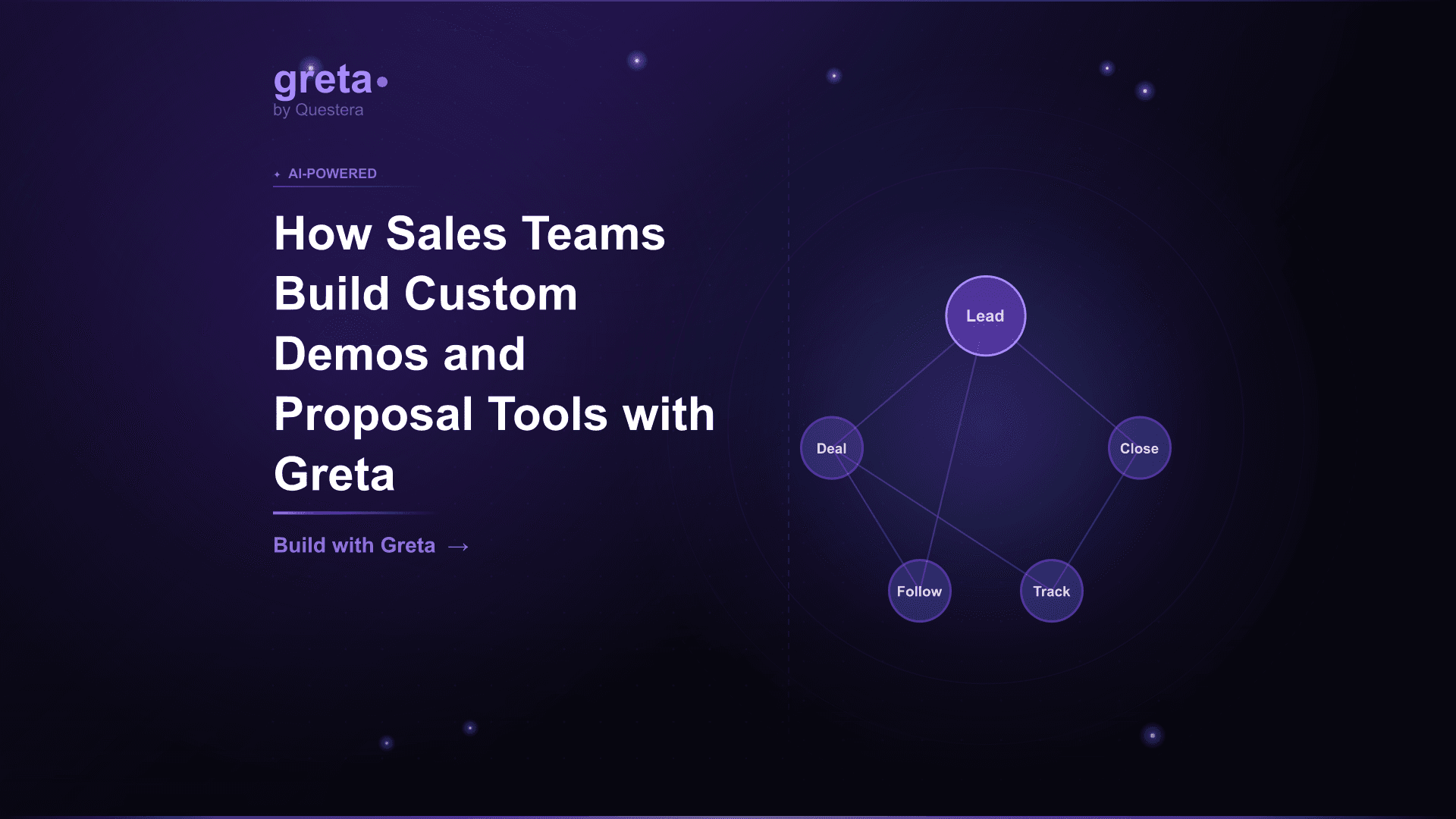
TL;DR: Sales teams need custom assets that engineering can't prioritize --- interactive demos personalized per prospect, ROI calculators specific to their deal, branded proposal pages replacing 40-page PDFs, deal rooms consolidating everything for buying committees. AI app builders close this gap. Sales reps build deal rooms in 20--45 minutes instead of waiting weeks. Conversion rates improve significantly. Integrates with CRM, email, calendar, and document signing. This guide covers what to build, the architecture, the patterns that work, and the realistic playbook for sales teams ready to upgrade their toolkit.
Introduction
Sales teams in 2026 face a tooling gap. Marketing has Webflow and AI app builders to ship landing pages. Engineering has Cursor and AI app builders to ship features. Customer success has Notion and structured workflows. But sales --- the team responsible for actually closing revenue --- often operates with PowerPoint decks, generic PDFs, and shared spreadsheets that aren't fit for purpose.
The assets sales teams genuinely need are custom and prospect-specific. Interactive demos personalized for the prospect's context. ROI calculators that reflect their actual deal size. Branded proposal pages that replace 40-page PDFs with web experiences. Deal rooms consolidating everything for the buying committee. Each of these would lift conversion rates measurably. None of them rank high on engineering's roadmap.
AI app builders close this gap. Sales teams can now build the custom assets they need without engineering bottleneck. Interactive demos that take 3 hours to build instead of 3 weeks of waiting. ROI calculators specific to each deal. Proposal microsites that feel premium. Deal rooms that compress the buying experience. This guide covers what to build, the architecture, the patterns that work, and the realistic playbook for sales teams ready to upgrade their toolkit.
Why sales teams need custom tooling
- Generic demos lose to personalized demos consistently
- Static PDFs lose to interactive experiences
- ROI claims need to feel specific to the buyer to be credible
- Buying committees need single source of truth (not email chains)
- Competitor sales teams are using better tooling; matching matters
- Sales velocity improves when assets are personalized and accessible
What sales teams build with AI app builders
Interactive demos
- Demo environment that looks like the prospect's company (logo, name, sample data)
- Click-through walkthrough of the product with their context
- Personalized for industry, use case, deal size
- Sent as URL the prospect can revisit and share internally
- Engagement tracking (who clicked what, when)
- Replace generic 'request a demo' flows with personalized exploration
ROI calculators
- Prospect inputs their numbers (team size, current spend, hours saved)
- Calculator outputs personalized ROI and savings
- Specific to the deal context, not generic
- Saves output as PDF for sharing internally
- Email gate captures lead info if standalone
- Often the single highest-leverage sales asset
Proposal pages (microsites)
- Web-based proposal replacing 40-page PDF
- Sections: executive summary, problem statement, proposed solution, pricing, timeline, terms
- Embedded videos for personal touch
- Interactive elements (expandable sections, pricing configurator)
- Mobile-friendly (buying committees read on phones)
- Comments or questions feature for buyer feedback
- Conversion rates often 2--3x higher than PDF proposals
Deal rooms
- One URL containing everything the buying committee needs
- Custom demo for them
- Their ROI calculation
- Proposal and contract
- Security documentation (SOC 2, DPA)
- FAQ specific to their concerns
- Customer testimonials in their industry
- Single asset to share with procurement, legal, security, and executive sponsor
Competitive comparison pages
- Honest comparison vs the competitor in the deal
- Specific to the features that matter for this prospect
- Personalized URL to share with buying committee
- Higher trust than 'us vs them' battle cards
Champion-enablement tools
- Tools the internal champion can use to sell internally
- Templates for internal pitch decks
- Specific value framing for different stakeholders (CFO, CIO, CMO)
- Pre-built slides champion can include in internal presentations
- ROI calculations they can defend
Sales onboarding tools
- Interactive training for new sales reps
- Playbook tools with situational guidance
- Discovery question library searchable by deal context
- Objection handling guides personalized by industry
Got an idea? Build it now!
Just start with a simple prompt. No coding required: Greta.sh turns your idea into a working app in minutes.
The architecture (what's underneath)
For interactive demos
- Multi-tenant data model where each prospect has their own demo data
- URL pattern: app.yoursaas.com/demo/{prospect-slug}
- Demo data seeded from CRM info or sales rep input
- Read-only by default (prospect can explore but not modify)
- Optional: limited write mode for prospects to try features
For ROI calculators
- Form for prospect inputs
- Calculation logic specific to your value proposition
- Results page with personalized output
- PDF export for sharing
- Save calculation as URL for prospect to revisit
- Lead capture if used in marketing context
For proposal pages
- Template-based with custom sections
- Variables for prospect-specific content (company name, deal size, timeline)
- Rich media support (embedded videos, images)
- Comments/questions feature
- Read-receipt and engagement tracking
- Versioning for proposal updates
For deal rooms
- Single URL per deal
- Auth optional (some prefer public URLs; others require email gate)
- Curated assets specific to deal
- Activity tracking (who viewed what)
- Easy to add new assets as deal evolves
The sales rep workflow
Building a deal room
- Sales rep starts a new deal in the tool
- Enters prospect details (company, industry, deal size, contacts)
- Tool generates personalized demo, ROI calc starting point, proposal template
- Rep customizes for the specific deal (add notes, adjust numbers, customize messaging)
- Sends URL to prospect
- Tracks engagement (who's viewed, what they looked at, how long)
- Uses engagement signals to time follow-up appropriately
Time per deal room
- First deal room: 1--2 hours (learning the tool)
- Subsequent deal rooms: 20--45 minutes
- Pure personalization time, not building infrastructure
- Reps doing 3--5 deal rooms per week is reasonable
Integration with sales stack
CRM integration
- Deal rooms tied to deals in Salesforce, HubSpot, etc.
- Engagement data flows back to CRM (which assets viewed by which buyer)
- Lead source tracking through deal room URLs
Email and calendar
- Easy share via email (smart subject lines, preview cards)
- Calendar integration for scheduling demos within deal room
- Follow-up automation based on engagement signals
Document signing
- DocuSign or HelloSign integration for contract execution
- Contracts accessible within deal room
- Signature tracking visible to rep
Got an idea? Build it now!
Just start with a simple prompt. No coding required: Greta.sh turns your idea into a working app in minutes.
Pricing tools that move deals
Interactive pricing configurator
- Prospect can see different pricing tiers
- Adjust team size, contract length, modules to see pricing change
- Self-discovery of best fit
- Reduces pricing-as-objection by making it transparent
Discount approval workflow
- Rep requests discount above their threshold
- Manager approves in tool
- Audit trail of who approved what when
- Replaces email-based approval chains
Quote-to-proposal
- Build quote with line items
- Generates branded proposal automatically
- Includes proposal in deal room
- Quote changes update proposal
What this replaces
- Generic 'request a demo' pages → personalized interactive demos
- Static PDF proposals → web-based proposal pages
- Generic ROI claims → calculator-driven specifics
- Email chains with attachments → deal rooms with everything
- Spreadsheet quotes → proposal-integrated configurators
- Generic battlecards → personalized competitive comparison pages
- Sales engineer time on demos → self-service personalized demos for early stage
Common Mistakes
- Treating it as marketing technology --- Sales and marketing have different needs. Build for sales workflows specifically.
- Over-personalizing --- Some personalization is signal; too much feels manufactured. Balance.
- Skipping engagement tracking --- Knowing who looks at what informs follow-up timing. Don't skip.
- Building too much before testing --- Ship one deal room template; iterate based on actual deal outcomes.
- Reps not actually using the tool --- If reps aren't using it, fix the friction. Tools that aren't used produce no value.
- No mobile optimization --- Buying committees read on phones. Test on mobile thoroughly.
- Ignoring buyer experience --- Sales tools should benefit the buyer, not just the seller.
- Forgetting the contract --- Deal room without contract execution is incomplete.
- Hiding pricing --- Transparent pricing in deal rooms often accelerates deals.
- Underestimating training --- Even great tools need rep onboarding.
- Not tying to CRM --- Disconnected tools cause double-entry and lost data.
- Over-engineering for first version --- Ship the basics; learn what reps actually need.
Got an idea? Build it now!
Just start with a simple prompt. No coding required: Greta.sh turns your idea into a working app in minutes.
Frequently Asked Questions
Q1: Why not use existing sales enablement tools (Highspot, Seismic)? They work for the parts they cover well --- content management, basic deal rooms. They struggle with deep personalization and custom logic (ROI calculators with your specific business model, interactive demos with your product data). AI app builders extend what's possible beyond what off-the-shelf sales enablement tools cover.
Q2: How does this work with our CRM? Integration via APIs or webhooks. Deal rooms tied to deals; engagement events flow back to CRM as activities. Most CRMs (Salesforce, HubSpot, Pipedrive) have good API support for this.
Q3: What about security for proposals and contracts? Standard auth and access controls. Use email-gated access for sensitive content. Use document signing tools (DocuSign) for contract execution rather than rebuilding that. Audit logs for compliance contexts.
Q4: Can ROI calculators backfire if numbers don't pan out? Yes, if claims are inflated. Use conservative assumptions; document them clearly; offer to discuss methodology. Trust matters more than the impressive number.
Q5: What about competitors seeing our sales tools? Most deal rooms are URL-shared; if URLs leak, competitors might see them. Most companies tolerate this --- content is meant to win deals; competitors seeing it has limited downside. For very sensitive content, use auth and access logs.
Q6: How do we measure ROI of building these tools? Conversion rate changes (deals with deal rooms vs without). Velocity changes (time from first touch to close). Win rate changes against competition. Rep productivity (deals worked per quarter). The metrics that matter for sales operations.
Q7: What if reps are old-school and resist new tools? Show one rep win with the tool. Replicate. Don't force; demonstrate value. Old-school reps adopt when they see the tool helping their peers close more. Sales is competitive; tool advantages spread fast within teams.
Conclusion
- Sales teams need custom assets that engineering can't prioritize --- interactive demos, ROI calculators, branded proposals, deal rooms. AI app builders close the tooling gap.
- Patterns: interactive demos (personalized per prospect), ROI calculators (specific to their context), proposal microsites (replace 40-page PDFs), deal rooms (one URL with everything for buying committee), competitive comparison pages.
- Integrates with sales stack --- CRM for deal data, email/calendar for outreach, document signing for execution. Engagement tracking informs follow-up timing.
- Time per deal room: 1--2 hours for first; 20--45 minutes for subsequent. Reps can ship 3--5 deal rooms per week. Conversion rates often improve significantly.
If your sales team is operating with generic decks and PDFs, evaluate AI app builders for sales tooling this quarter. Pilot with one rep building one deal room for one active deal. Measure conversion and velocity. Roll out to the team based on results. The sales teams adopting AI app builders in 2026 are shipping personalized buyer experiences that competitors can't match without similar tooling. The capability is real; the organizational adoption is the variable. Don't compete with generic decks; build the custom assets that move deals.