TL;DR: No single no-code tool covers a founder's whole stack --- most successful no-code businesses run on two or three of these at once. Zapier and Make handle automation between tools. Webflow handles marketing sites that need real design control. Airtable handles structured business data. Retool handles internal back-office tools. Notion handles docs and lightweight databases. Bubble handles full visual app-building. Greta.sh is the pick when you want the app, the growth tooling, and the ability to describe changes in plain English, all from one workspace instead of stitching several of these together.
Introduction
"No-code" isn't one category anymore --- it's a stack. A founder running a real business in 2026 is rarely using just one no-code tool; they're usually running an automation layer, a website builder, a data layer, and sometimes an internal-tools platform at the same time, each solving a different piece of the puzzle.
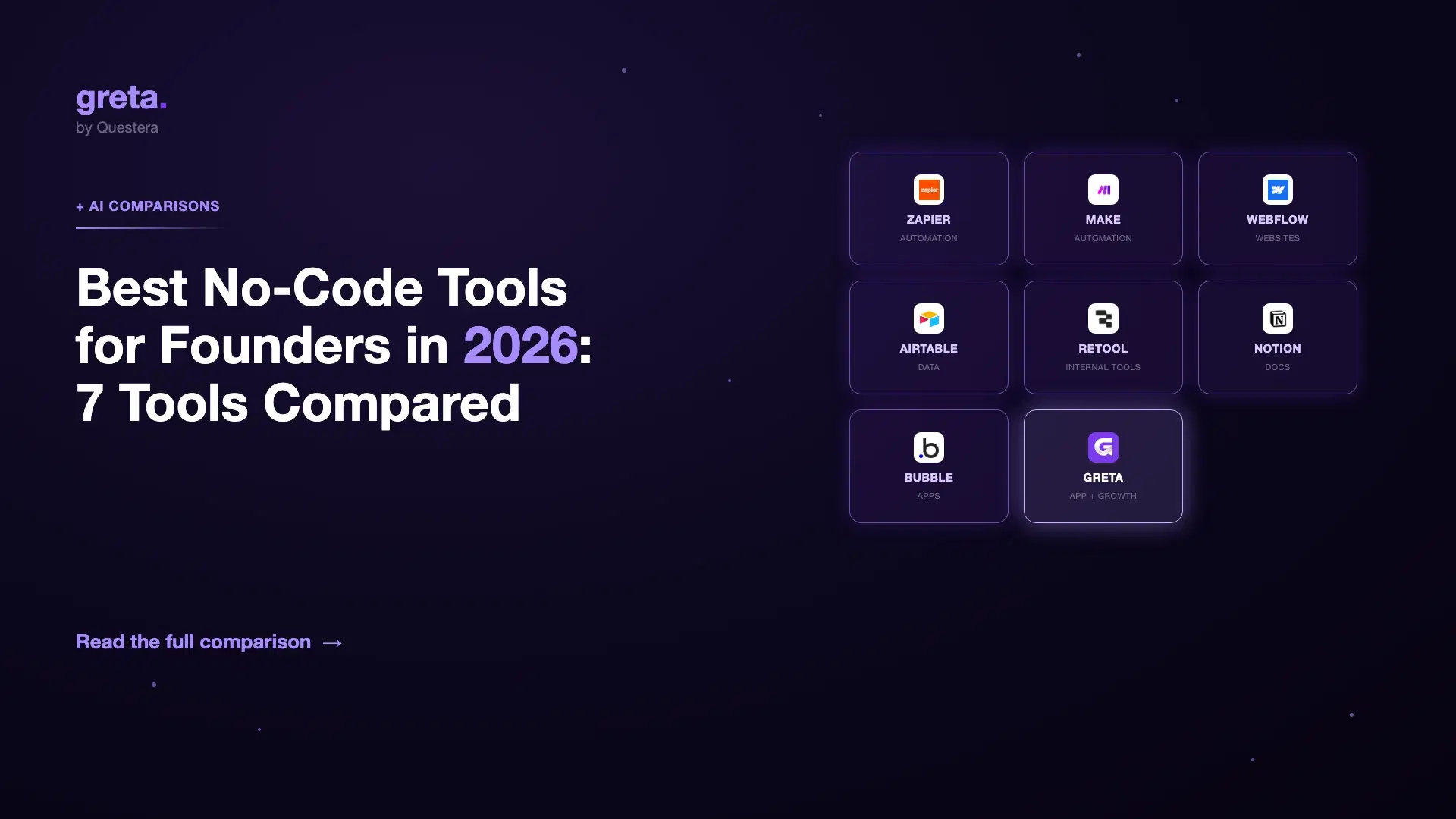
This guide covers the seven no-code tools that come up most often in a founder's stack: Zapier, Make, Webflow, Airtable, Retool, Notion, and Bubble --- plus where Greta.sh fits as the AI-native option that collapses several of these into one workspace.
The seven, at a glance
| Tool | Solves | Best for | Pricing (entry) | Ceiling |
|---|---|---|---|---|
| Zapier | Automation between tools | Founders who want the widest integration library with minimal setup | Free tier, paid from ~$30/mo | Simple, linear workflows; complex branching gets expensive fast |
| Make | Automation with real branching logic | Founders who've outgrown Zapier's linear workflows | Free tier, paid from ~$16/mo | Steeper learning curve than Zapier for the same task |
| Webflow | Marketing sites and landing pages | Founders who need real design control, not a template | Free tier, paid from ~$25/mo | Not built for complex app logic or user accounts |
| Airtable | Structured business data | Teams that have outgrown spreadsheets but don't need a full app | Free tier, paid from ~$24/mo | Becomes an app-building workaround past a certain complexity |
| Retool | Internal tools over existing data | Support screens, admin panels, refund tools, moderation dashboards | Free tier, paid from ~$12/builder/mo | Built for internal tools, not customer-facing products |
| Notion | Docs, wikis, lightweight databases | Internal knowledge base and simple structured tracking | Free tier, paid from ~$12/mo | Not a real database or app platform past simple use cases |
| Bubble | Full visual app builder | Complex, workflow-heavy apps built visually | Free tier, paid from ~$69/mo | Hosted-only, no code export, steepest learning curve here |
| Greta.sh | App plus the business around it | Founders who want to describe changes in English rather than assemble tools | Subscription, bundled capacity | Newer category --- less third-party plugin depth than Zapier or Bubble |
Zapier --- the default choice for automation
Zapier's advantage is breadth: 6,000+ integrations and the lowest learning curve of any automation tool on this list. If a founder needs "when X happens in tool A, do Y in tool B," Zapier almost certainly already has both tools in its library, and the setup is close to point-and-click.
The tradeoff shows up as workflows get more complex. Zapier is built for straightforward, mostly-linear automations; once you need heavy branching logic, conditional paths, or serious data transformation between steps, costs and complexity both rise faster than they do on Make.
Got an idea? Build it now!
Just start with a simple prompt. No coding required — Greta.sh turns your idea into a working app in minutes.
Make --- for automation that's outgrown Zapier
Founders switch to Make specifically when Zapier starts feeling limiting: Make handles branching logic, data cleanup, and multi-step scenarios more capably, usually at a lower cost per operation. The visual flow-builder interface makes complex automations easier to actually understand later, which matters once a workflow has more than a handful of steps.
The cost is a steeper learning curve --- Make rewards the time invested in learning it, but it's a real step up in complexity from Zapier's simplest workflows.
Webflow --- for a marketing site that needs to look designed, not templated
Webflow occupies a specific niche: real visual design control over a marketing site or landing page, without hand-coding CSS. For founders whose product lives elsewhere (an app, a SaaS backend) but who need a site that looks genuinely designed rather than assembled from a generic template, Webflow remains the strongest option.
It isn't built for application logic, user accounts, or anything beyond content and design --- that's not its job, and stretching it to do app-like things is usually the wrong call.
Airtable --- for business data that's outgrown a spreadsheet
Airtable is the bridge between "a spreadsheet" and "a database" --- structured, relational data with a spreadsheet-familiar interface, plus enough automation and view flexibility to run real business processes (CRM-lite, content calendars, inventory tracking) without engineering.
The limitation shows up when teams start using Airtable's automations and interfaces to effectively build an app on top of it. At that point, the workaround usually costs more time than just using a tool built for app logic in the first place.
Got an idea? Build it now!
Just start with a simple prompt. No coding required — Greta.sh turns your idea into a working app in minutes.
Retool --- for the internal tool every business eventually needs
Every no-code business eventually needs internal software that customers never see: a support screen, a refund tool, a user lookup, a moderation panel. Retool exists specifically for this --- building admin interfaces over existing data sources fast, without dedicating engineering time to tooling that doesn't touch revenue directly.
Retool is explicitly not for customer-facing products. Its entire value proposition is being the fast, unglamorous back-office layer behind a real business.
Notion --- for docs and lightweight tracking, not a real database
Notion's strength is flexibility for unstructured and semi-structured information: internal wikis, meeting notes, lightweight project tracking, simple databases with relations. For a small team's internal knowledge base, it's hard to beat on ease of use.
It isn't a real database platform, and pushing it past simple structured-tracking use cases (as some founders try) usually means fighting the tool rather than using it.
Bubble --- the deepest full-app visual builder
Bubble remains the most capable true visual app builder on this list --- a genuine drag-and-drop editor, the deepest plugin ecosystem in the no-code category, and a track record of real, complex, workflow-heavy apps built entirely visually rather than from a prompt.
The tradeoffs: Bubble apps are hosted-only with no code export, and the learning curve for building anything non-trivial is the steepest of the tools covered here.
Got an idea? Build it now!
Just start with a simple prompt. No coding required — Greta.sh turns your idea into a working app in minutes.
Where Greta.sh fits
Every tool above solves one piece of a founder's stack well. Greta.sh's bet is different: instead of assembling automation (Zapier/Make), a marketing site (Webflow), data (Airtable), and an app (Bubble) as four separate tools, Greta.sh generates the app itself from a plain-English description and bundles domain setup, basic SEO, analytics, and content management into the same workspace.
That doesn't replace Retool for deep internal tooling, or Make for genuinely complex automation chains --- but for a founder whose core need is "an app plus the business surface around it," Greta.sh collapses what would otherwise be three or four separate tool subscriptions and setups into one.
Which one should you actually reach for?
- Reach for Zapier if you need the widest integration library and your automations are mostly simple and linear.
- Reach for Make if you've outgrown Zapier's linear workflows and need real branching logic.
- Reach for Webflow if the deliverable is a marketing site that needs to look genuinely designed.
- Reach for Airtable if you've outgrown a spreadsheet but don't need a full application.
- Reach for Retool the moment you need an internal tool your customers will never see.
- Reach for Notion for docs, wikis, and lightweight internal tracking.
- Reach for Bubble if the deliverable is a complex app best built visually rather than described.
- Reach for Greta.sh if you want the app itself, plus its growth tooling, generated from a description rather than assembled from parts.
Frequently Asked Questions
Q1: Do founders really use more than one of these at once? Almost always. A typical stack might be Webflow for the marketing site, Airtable for data, Zapier or Make gluing them together, and Retool for the internal support tooling once the business has real customers.
Q2: Which is cheapest to start with? Zapier, Make, Webflow, Airtable, Retool, Notion, and Bubble all have usable free tiers. The real cost usually shows up later, in seats, operations, or complexity, not at signup.
Q3: Can Greta.sh replace this whole stack? Not entirely --- Greta.sh focuses on the app plus its immediate growth surface (domain, SEO, analytics, content). Deep automation (Make), internal admin tooling (Retool), and general docs (Notion) are still better served by tools built specifically for those jobs.
Q4: Which of these is easiest for a complete beginner? Zapier for automation, Notion for docs, and Airtable for data are all genuinely approachable with no prior no-code experience. Bubble and Make both reward time invested in learning them.
Q5: Is no-code actually viable for a real business, not just a prototype? Yes --- by 2026 the ecosystem has matured enough that businesses have scaled to thousands of users and meaningful revenue on no-code foundations without ever transitioning to custom code, though most eventually mix in some engineering as they scale.
Got an idea? Build it now!
Just start with a simple prompt. No coding required — Greta.sh turns your idea into a working app in minutes.
Conclusion
There's no single winner in the no-code category in 2026 --- there's a stack. Zapier and Make for automation. Webflow for the marketing site. Airtable for data. Retool for internal tools. Notion for docs. Bubble for full visual app-building. Greta.sh for founders who'd rather describe the app and its growth surface in plain English than assemble it from four separate subscriptions.
Pick the piece that matches the actual gap in your stack today --- not the tool with the loudest marketing.