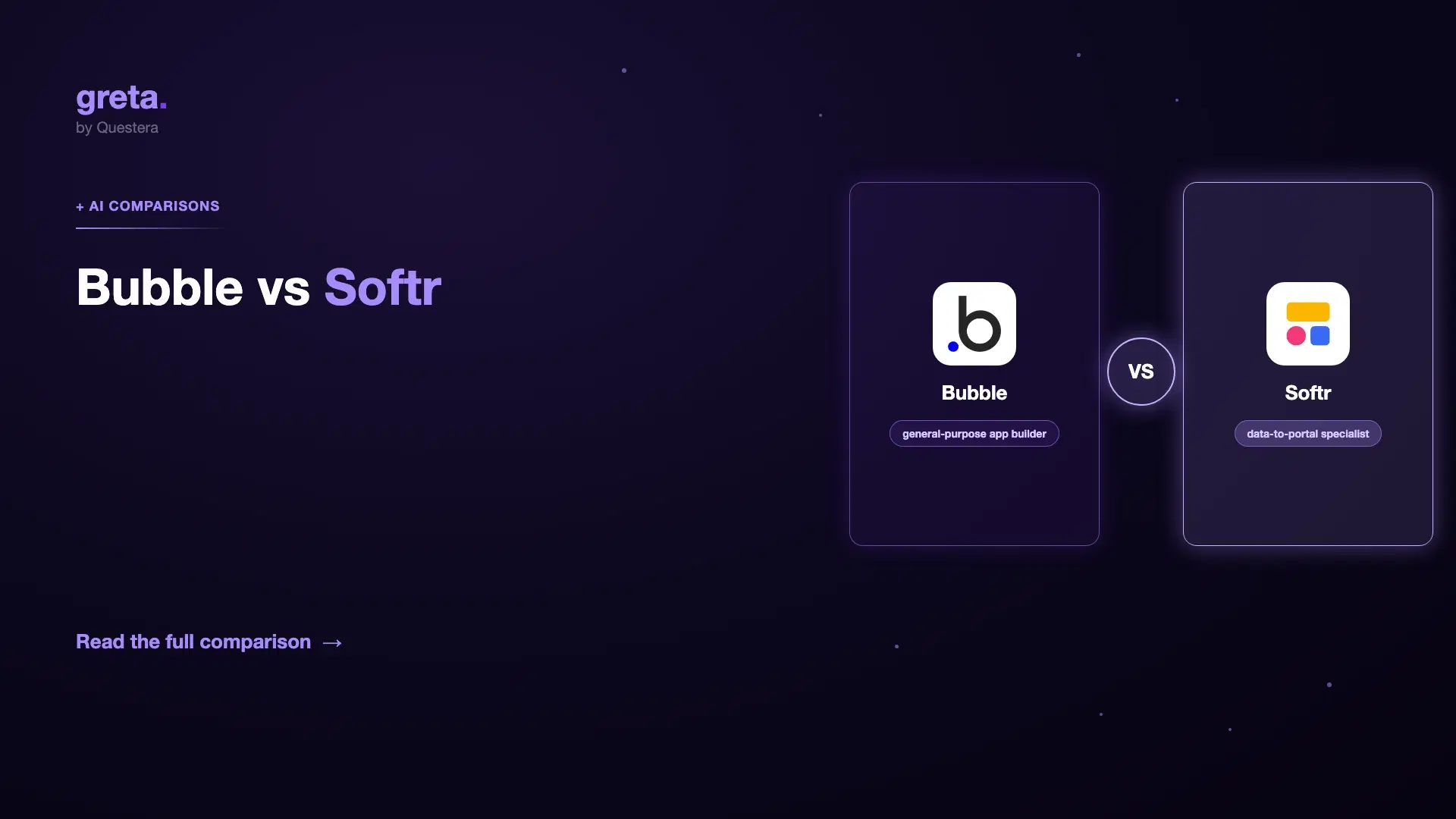
Bubble vs Softr: full app builder or Airtable-powered client portals?
For a client portal, Softr is the faster choice when your client data already lives in Airtable, Google Sheets, a CRM or Softr's own database: it ships client-portal templates, logins and record-level permissions, so you connect your data instead of rebuilding it. Bubble is the better choice when the portal is really a custom application, with its own data model, server-side workflows, payments logic or a mobile app. That split runs through every other comparison below: Softr puts a polished, permissioned front end on data you already manage, while Bubble is a general-purpose visual builder where you design the database and the logic yourself. Both are hosted-only, with no code export. If you'd rather describe the app in plain English than assemble it visually, Greta.sh generates the full stack from a prompt.
Bubble vs Softr: quick verdict
- Choose Softr if you need a client portal, internal tool or directory on top of data you already have, and you want it live quickly.
- Choose Bubble if you're building a genuinely custom product (a marketplace, a SaaS, an app with complex server-side logic) and you're willing to learn its editor.
- Consider Greta.sh if you'd rather describe the app in plain English than wire it up visually either way.
Whether you search it as Bubble vs Softr or Softr vs Bubble, the real distinction is general-purpose app builder versus data-to-portal specialist.
How do Bubble and Softr compare at a glance?
| Bubble | Softr | |
|---|---|---|
| Best for | Custom web and mobile apps built from scratch | Client portals, internal tools and directories on existing data |
| Data | Bubble's built-in database, designed by you | Softr Databases, or 20+ native sources including Airtable, Google Sheets, HubSpot, Notion, Supabase and SQL databases |
| Logic | Front-end and back-end workflows, scheduled and API workflows, privacy rules | Softr Workflows (triggers, integrations, AI actions, API calls, custom code), plus user groups and page, block and record permissions |
| Mobile | Mobile apps on the Mobile or Web & Mobile plans | Web apps; PWA and push notifications on Business |
| Code export | No | No (no self-hosting) |
| Free plan | Yes: development version only, no live app or custom domain | Yes: unlimited apps, 5 app users, 5,000 records; custom domain from Basic |
| Entry paid plan | Web Starter $29/mo billed yearly ($32 monthly) | Basic $19/mo billed yearly ($25 monthly) |
| Pricing basis | Per app, metered in workload units (server work) | Per workspace, capped by app users, records and workflow actions |
Prices as of October 2026, from bubble.io/pricing and softr.io/pricing. Bubble has announced that from October 20, 2026 the Web Starter plan rises to $32/month billed yearly or $39 monthly (Bubble).
Got an idea? Build it now!
Just start with a simple prompt. No coding required: Greta.sh turns your idea into a working app in minutes.
Bubble vs Softr for building a client portal
This is the question most people bring to this comparison, so here's the direct answer.
Softr is built for it. It has a client portal use case and ready-made templates for client, investor and SaaS-customer portals. Logged-in users can be sorted into user groups that control which pages, blocks and individual records each client sees, so client A only ever sees client A's projects, invoices and files. If those records already sit in Airtable, Google Sheets or a CRM, you connect the source rather than rebuilding it.
The catch with Softr is user count. Plans include a set number of app users per workspace: 5 on Free, 5 team plus 5 client users on Basic, 10 team plus 50 client users on Pro ($99/month billed yearly, $119 monthly), and 30 team plus 100 client users on Business ($329 yearly, $395 monthly). Granular permissions also start on Pro. For a portal with a few dozen clients, Pro is the realistic starting plan.
Bubble can build a client portal too, but you build it. You design the data types (clients, projects, files, invoices), write privacy rules so each client sees only their own records, and lay out every page. Bubble's pricing is per app and metered on server work rather than on how many clients log in, which helps if the portal has many light users. Choose Bubble when the portal needs logic Softr's blocks don't cover: quotes that calculate, multi-step onboarding, or billing rules of your own.
Agencies and developers building portals for clients should look at how each one bills. Softr's plans are per workspace with unlimited apps, so several small client portals can share one plan, but users are counted across the workspace (the same email in two apps counts once). Bubble's plans are per app ("each project has its own plan," per Bubble's pricing FAQ), so ten client apps mean ten plans; Growth includes 2 editors and Team 5. Neither exports code, so whichever you choose, the client stays on that platform.
Can Softr handle custom workflows the way Bubble can?
For most business automation, yes; for application logic, not to the same depth.
Softr Workflows is included on every plan. Workflows can start from a button in your app, a new user, a Softr Database record change, an Airtable or Google Sheets change, a Gmail message, a webhook or a schedule, and they can call integrations, run AI actions, call an API, branch, wait, and run custom JavaScript or Python (code steps are on paid plans). The limit is volume: plans include 500 workflow actions a month on Free, 2,500 on Basic, 10,000 on Pro and 25,000 on Business, and workflows pause when you hit the cap.
Bubble's workflows are the app itself. Front-end workflows respond to clicks and inputs, and back-end workflows run server-side, either scheduled or triggered from outside through Bubble's Workflow API. The API Connector is available on the free plan. The cost is predictability: what Bubble does on the server (database operations, workflows, web requests) consumes workload units, 175,000 a month on Starter, and overage without a workload tier is $0.30 per 1,000 units.
Rule of thumb: if the workflow is "when X happens, update a record, notify someone, call a service," Softr handles it. If the workflow is the product (pricing engines, matching, multi-step state machines), Bubble is the closer fit.
Is Softr or Bubble better for a directory or marketplace app?
For a directory, Softr. List, filter and detail blocks over a table are what Softr does fastest, and its template library includes employee, vendor and supplier directories.
For a marketplace, Bubble. A two-sided marketplace needs buyer and seller roles, listings, orders and money moving between parties. Bubble's template gallery has Marketplace and Directory & listings categories, and its manual has a dedicated marketplace payments guide alongside the official Stripe plugin. Softr supports Stripe Checkout for one-time and subscription payments, the Stripe customer portal and PayPal, which covers selling access or a paid listing. We found no marketplace template in its library, though, and its user caps work against a public marketplace with many sellers.
Got an idea? Build it now!
Just start with a simple prompt. No coding required: Greta.sh turns your idea into a working app in minutes.
Bubble vs Softr for a no-code SaaS
A SaaS product needs sign-up, subscriptions, per-customer data isolation and room to grow. Bubble is the more natural fit: it has a SaaS template category, Stripe subscriptions through its plugin, privacy rules for tenant isolation, and plans metered on workload units rather than end users. Softr can gate pages behind a Stripe subscription and has a SaaS customer portal template, which suits a membership site or a paid portal over shared data. A consumer-scale SaaS would outgrow Softr's app-user limits (100 client users on Business; Enterprise is custom).
If you want a SaaS you can eventually hand to developers, note that neither exports code. That's the main reason founders compare both against AI app builders that generate real code; our Greta.sh vs Softr comparison covers that trade-off.
Bubble vs Softr: pricing compared
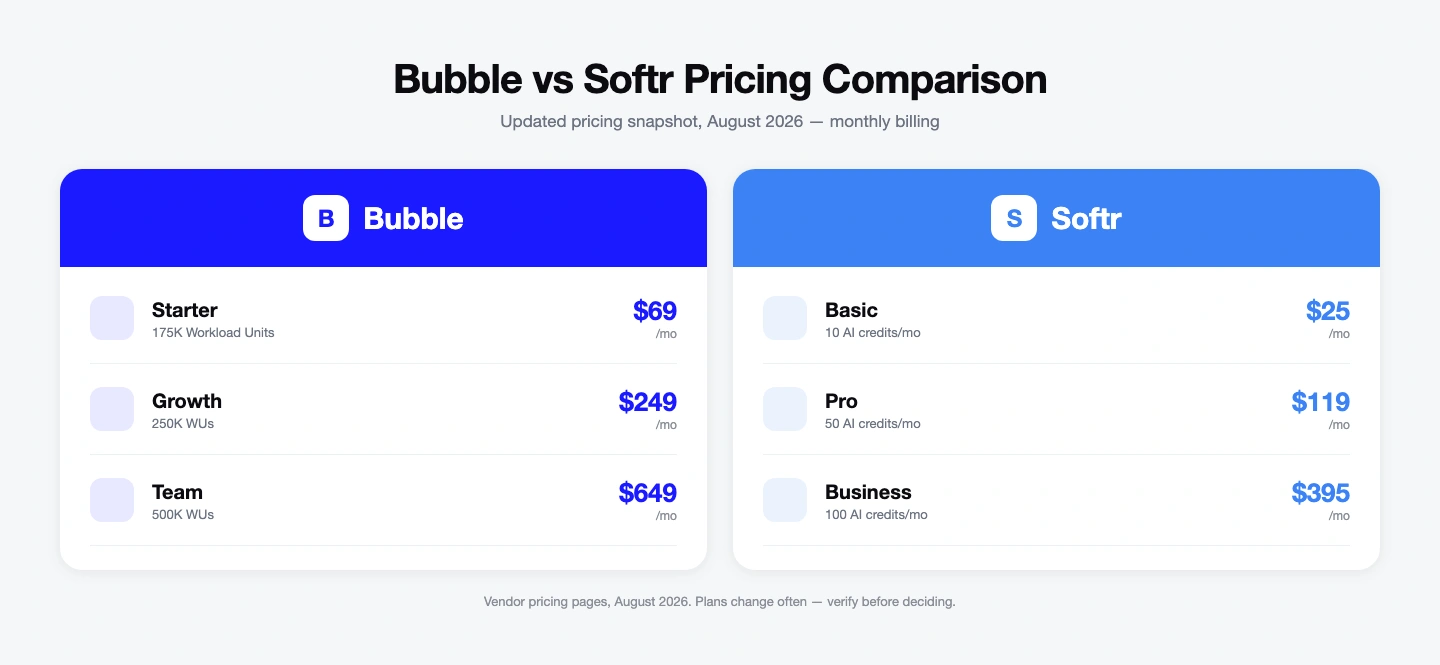
The entry prices are close; the meters are not. Softr's Basic plan is $19/month billed yearly ($25 monthly). Bubble's cheapest live plan is Web Starter at $29/month billed yearly ($32 monthly) until October 20, 2026, then $32 and $39; if you also want mobile apps, Starter on the Web & Mobile tab is $59 yearly ($69 monthly).
What you pay for differs. Bubble charges per app and meters server work in workload units, which is hard to predict for a busy app but doesn't depend on your user count. Softr charges per workspace and caps app users, records and workflow actions, which is predictable as long as you know roughly how many people will log in. Both now include monthly AI credits for their AI builders (1,000 on Bubble's Starter; 10 on Softr's Basic).
Bubble vs Softr by use case
| Use case | Better choice | Why |
|---|---|---|
| Client portal over existing data | Softr | Client-portal templates, user groups and record-level permissions out of the box. |
| Client portal with custom logic (quotes, billing rules) | Bubble | You design the data model and server-side workflows yourself. |
| Directory or member listing | Softr | List, filter and detail blocks over a table; directory templates included. |
| Two-sided marketplace | Bubble | Marketplace templates and a marketplace payments guide. |
| SaaS product with subscriptions | Bubble | Stripe subscriptions, privacy rules and pricing metered on server work, not users. |
| Internal dashboard over a spreadsheet | Softr | Connects to Sheets or Airtable instead of rebuilding the data. |
| Mobile app | Bubble | Mobile and Web & Mobile plans publish mobile apps. |
Got an idea? Build it now!
Just start with a simple prompt. No coding required: Greta.sh turns your idea into a working app in minutes.
Which should you choose: Bubble or Softr?
If your data already exists and the job is giving clients, staff or members a secure view of it, Softr gets you there faster and costs less to run. If you're building a product with its own data model and logic, Bubble's depth is worth its learning curve. See Best Bubble Alternatives in 2026 for the fuller category comparison, and our client portal software roundup if the portal is the whole project.
Frequently asked questions
How does Bubble compare to Softr for building a client portal? Softr is faster when your client data already exists: it has client-portal templates, user groups and record-level permissions, and Pro ($99/month billed yearly) includes 50 client users. Bubble builds a portal from scratch, which takes longer but suits portals that need custom logic, and its per-app pricing is metered on server work rather than users.
Can Softr handle custom workflows the way Bubble can? For business automation, yes: Softr Workflows run on triggers such as button clicks, new users, record changes, webhooks and schedules, and can call APIs, run AI actions and run custom code. Bubble goes deeper because its server-side workflows are the application logic itself, at the cost of less predictable workload-unit pricing.
Is Softr or Bubble better for a directory or marketplace app? Softr for a directory, since listing and filtering data is its core strength. Bubble for a two-sided marketplace, which needs buyer and seller roles, orders and payments between parties; Bubble has marketplace templates and a marketplace payments guide.
What's the difference between Bubble and Softr for a no-code SaaS? Bubble is a general-purpose builder with Stripe subscriptions, privacy rules and pricing metered on server work, so it suits a SaaS product. Softr suits a paid portal or membership site over shared data, but its plans cap app users (100 client users on Business).
Is Bubble or Softr cheaper? Softr's entry plan is cheaper: Basic is $19/month billed yearly ($25 monthly) versus Bubble's Web Starter at $29 yearly ($32 monthly), rising to $32 and $39 on October 20, 2026. Real cost depends on the meter: Bubble scales with server work, Softr with users, records and workflow actions.
Can I export code from either? No. Bubble's manual says its code can't be exported to run somewhere else, and Softr doesn't offer self-hosting. If platform independence matters, that's a shared limitation.
What if I'd rather describe the app than build it visually? Both now include AI builders (Bubble's AI agent and Softr's AI Co-Builder), but you still finish the app in their visual editors. Greta.sh and Lovable are AI-native alternatives where you describe the app and keep changing it by prompt.
Prefer not to touch code? Build a full-stack app from a prompt → Try Greta.sh free
Best Bubble Alternatives in 2026 · All comparisons
Last updated: October 18, 2026. Pricing and features re-checked on each vendor's own pricing page and docs on October 12, 2026; confirm before relying on it.