Google AI Studio's vibe coding feature lets you describe an app in plain English and get a working, privately-hosted app with a real Firebase/Firestore backend and auth - built on Gemini, free to start. It's a genuinely capable prototyping tool. Where it stops: deploying beyond AI Studio's own sharing links runs through Google Cloud Run and needs a GCP billing account, and there's no built-in custom-domain or post-launch growth layer, you own that part yourself once you're out of prototype mode.
Google shipped this in two stages: an initial "vibe coding" launch in October 2025 (prompt-to-app, auto-wired Gemini APIs), then a March 2026 upgrade adding real full-stack capability - Firebase/Firestore for data and auth through what Google calls its Antigravity agent mode. That's a meaningfully more capable tool than most people assume when they hear "Google's vibe coding thing." This piece covers what it actually does well, and where a founder trying to launch and grow a real product will hit friction.
For us at Greta.sh, Google entering vibe coding is a strong signal that this is moving beyond an experimental way to prototype software. When a company with Google's developer ecosystem starts turning plain-English prompts into full-stack apps, the question is no longer whether AI will change how software gets built. It's how far these tools can take someone after the first version works.
That's the part we think matters most. Generating an app is getting easier across the board. The harder problem is everything that comes next: getting it live, connecting the pieces, improving it, getting it discovered, and turning a prototype into something people actually use. That's where we think the next phase of vibe coding will be won.
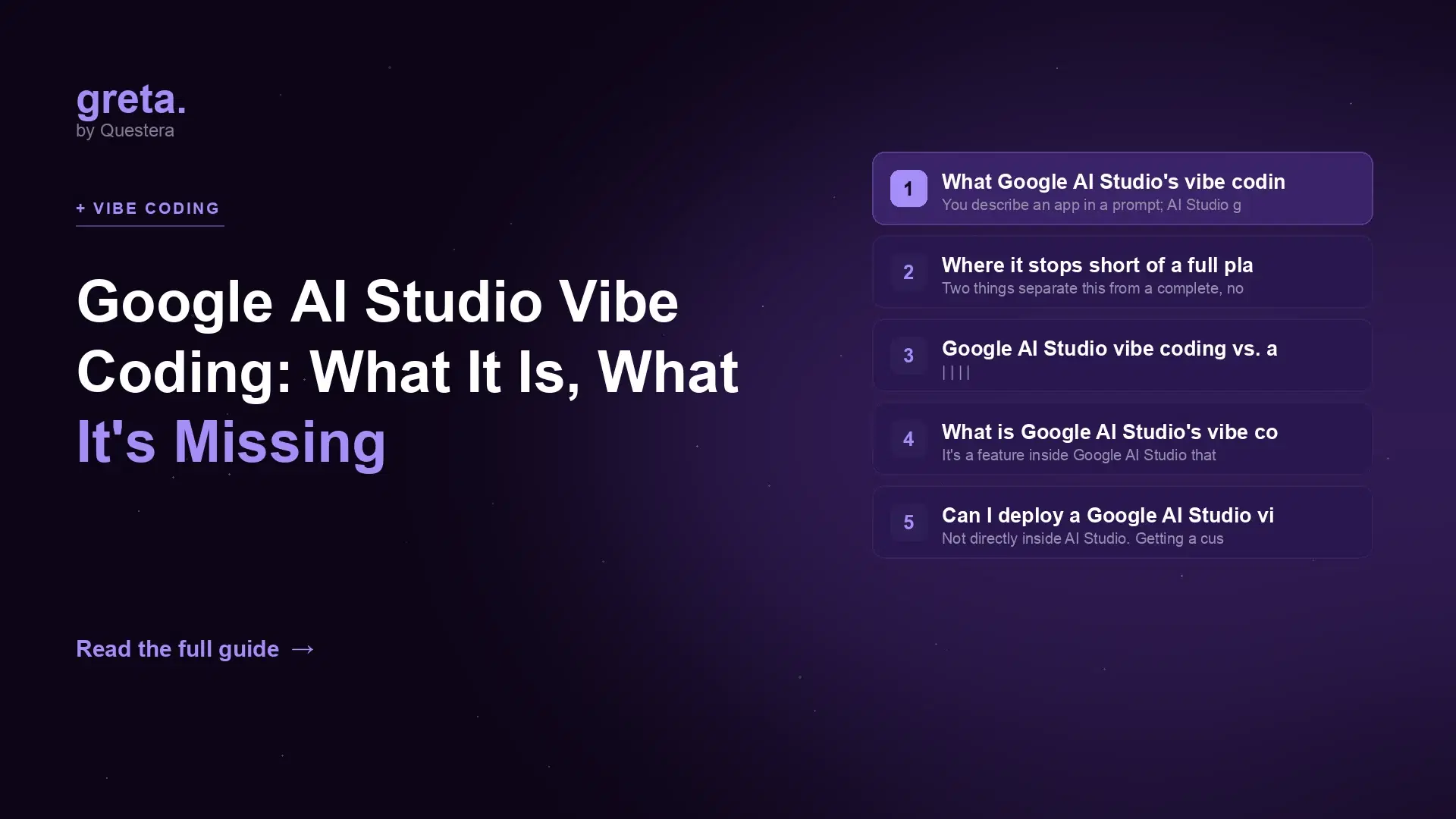
What Google AI Studio's vibe coding feature actually does
You describe an app in a prompt; AI Studio generates working UI and logic, wired natively to Gemini's APIs with a free tier. A few things distinguish it from most other vibe-coding tools:
- Private by default. Apps you build stay private unless you explicitly share them, many competing tools default to public visibility.
- Native Gemini integration, including voice dictation and visual annotation for iterating on the UI.
- A real backend, as of the March 2026 upgrade, Firebase/Firestore for data storage, plus user authentication, rather than just a frontend shell.
- Version control built in - checkpoints to revert to a known-good state, and GitHub sync for anyone who wants their code in a real repo.
That backend upgrade is the meaningful part. A lot of "vibe coding" tools generate a convincing UI and stop there; a real database and auth system is what turns a demo into something closer to a usable app.
Where it stops short of a full platform
Two things separate this from a complete, non-technical-founder-ready platform:
- Deployment beyond AI Studio's own sharing links goes through Google Cloud Run and that path requires a GCP billing account set up first. That's a real step for anyone without prior Google Cloud experience; it's not "click deploy and you're live on your own domain" the way a purpose-built launch platform works.
- No built-in custom domain or post-launch growth mechanism. Nothing in Google's own documentation or the practical guides covering this feature mentions connecting a branded domain, or anything resembling ongoing SEO/AEO optimization once the app is live. You get a capable app; growing an audience around it is left entirely to you.
Neither of those is a knock on the tool for what it's built to be - a free, Gemini-native way to prototype inside Google's ecosystem. They matter specifically if the plan is to launch a real product and grow it, not just build a working demo.
Google AI Studio vibe coding vs. a full launch-and-grow platform
| Google AI Studio (vibe coding) | A complete vibe-coding platform (e.g. greta.sh) | |
| Cost to start | Free, Gemini-native | Free (5 credits/day), Starter $20/mo list (currently $5/mo welcome offer), Pro $50/mo list (currently $20/mo welcome offer), Business $200/mo, Enterprise custom |
| Real backend (DB + auth) | Yes, since March 2026 | Yes |
| Live in one step | Via AI Studio share links | Yes |
| Custom domain | Not built in; requires separate GCP/Cloud Run setup | Built in |
| Post-launch SEO/AEO growth | Not built in | Automatic, built in |
| Best for | Prototyping inside Google's ecosystem, Gemini-native experiments | Going from idea to a live, growing product without a technical setup step |
To be fair to Google here: for someone already comfortable in Google Cloud, or building an internal/private tool rather than a public product, AI Studio's vibe coding is a strong, free option and the privacy-by-default design is genuinely a thoughtful choice most competitors don't make.
Got an idea? Build it now!
Just start with a simple prompt. No coding required: Greta.sh turns your idea into a working app in minutes.
Frequently asked questions
What is Google AI Studio's vibe coding feature?
It's a feature inside Google AI Studio that generates a working app, UI, logic, and since March 2026 a real Firebase/Firestore backend with authentication from a plain-English prompt, built natively on Gemini. Apps are private by default and can be shared via AI Studio's own links or deployed further through Google Cloud Run.
Can I deploy a Google AI Studio vibe-coded app to my own domain?
Not directly inside AI Studio. Getting a custom domain requires deploying through Google Cloud Run, which needs a GCP billing account and Cloud Run configuration, a genuine extra step compared to platforms where a custom domain connects directly during launch.
Is Google AI Studio's vibe coding tool good enough for a real product launch?
For prototyping, internal tools, or Gemini-native experiments, yes — it generates real working apps with a real backend. For a public product you plan to grow, the gap is what happens after the build: no built-in custom domain path and no post-launch SEO/AEO layer, so you'd need to handle growth and infrastructure separately from the build step.
How is Google AI Studio's vibe coding different from a platform like greta.sh?
Both let you build a full-stack app from a prompt. The difference is what happens next: greta.sh generates the app and deploys it live with a custom domain and an automatic, built-in SEO/AEO growth layer that keeps working after launch, while AI Studio hands you a working app that needs a separate Cloud Run/domain setup to go fully live and offers no built-in growth mechanism.