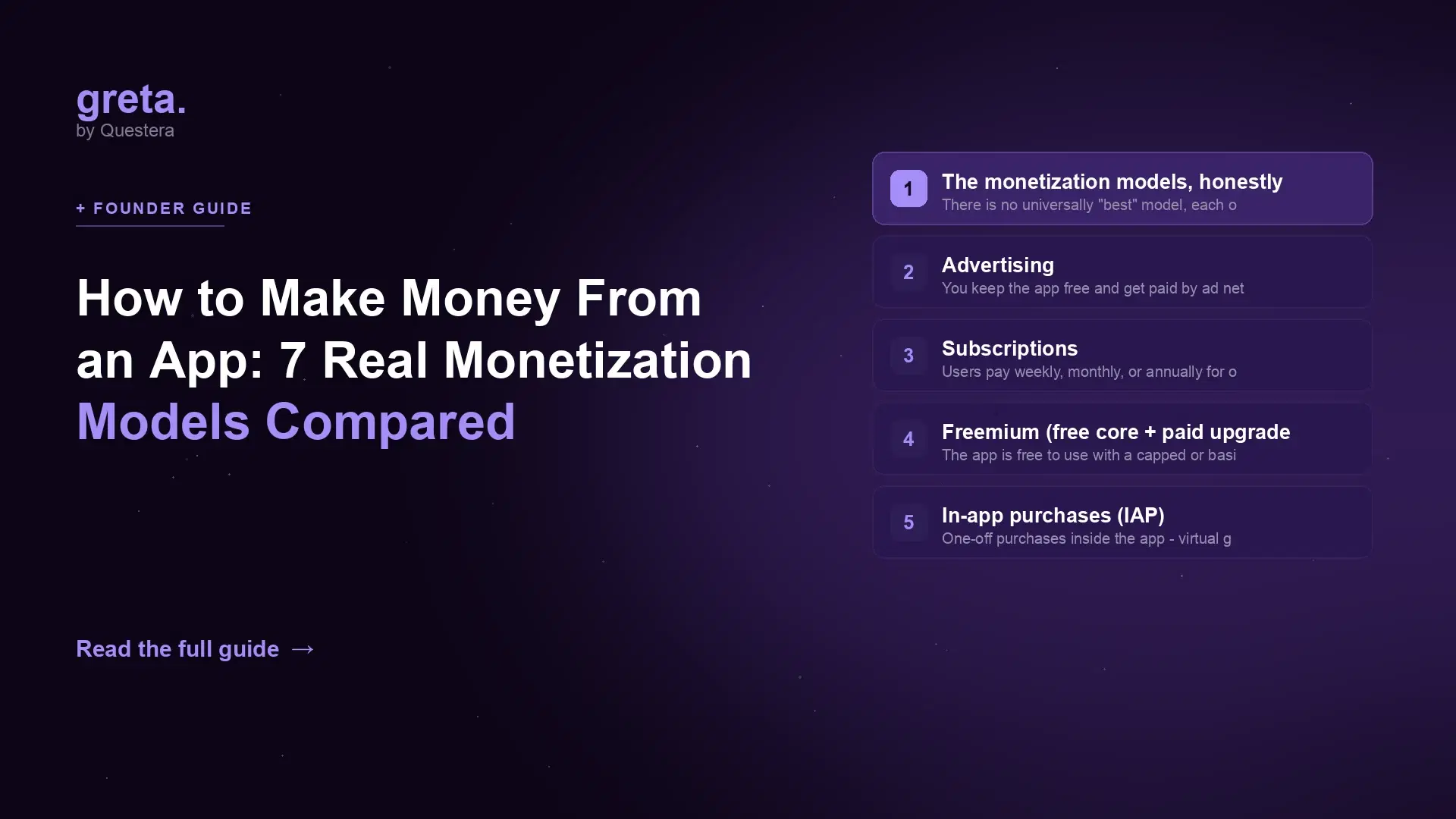
There's no single "right" way to make money from an app, there are seven or eight well-worn models (ads, subscriptions, freemium upsells, one-time purchase, in-app purchases, affiliate/referral, transaction fees, and sponsorship), and the right one depends on how often people use your app, how much value each use delivers, and how much it cost you to build it. Most successful apps combine two models rather than betting on one. The model that fits a $50,000 app with a full-time growth team is often the wrong model for a solo founder who built something in a weekend.
Most guides to app monetization list the same six or seven tactics and stop there, without connecting the choice back to what the app actually costs to build and run. That connection matters more than it used to. One thing we've noticed at Greta.sh is that cheaper building changes what "successful monetization" even means. If you spent six months and $50,000 building an app, a few hundred dollars a month in revenue probably isn't a win. If you built and launched the same idea in a weekend for a fraction of that cost, suddenly it can be.
That's why we see monetization as part of the build decision, not something to figure out afterward. Lowering the cost of creating and testing an app gives founders more room to try narrower ideas, experiment with pricing, and even build products for smaller audiences that wouldn't have made economic sense under traditional development costs. You don't necessarily need the monetization model with the biggest theoretical upside; you need one that makes sense relative to what the product costs you to build, run, and grow.
The monetization models, honestly
There is no universally "best" model, each one trades reach for revenue-per-user differently. Here's what each actually involves, based on how the major guides in this space (and real app economics) describe them.
Advertising
You keep the app free and get paid by ad networks (banner, interstitial, native, or rewarded video) per impression, click, or completed view. It requires a large, frequent-use audience to add up - a handful of downloads won't generate meaningful ad revenue. It's the lowest-friction model to add (SDK integration, no payment flow to build) and the lowest revenue-per-user of any option on this list.
Subscriptions
Users pay weekly, monthly, or annually for ongoing access. This is the highest-value model per user when it works, because it turns one download into recurring revenue instead of a single transaction but it also has the highest bar: people only subscribe to something they expect to keep getting value from, so the app needs a reason to be opened again and again, not just once.
Freemium (free core + paid upgrade)
The app is free to use with a capped or basic feature set; a paid tier unlocks more storage, more usage, or advanced features. This is arguably the most common model in the ecosystem. Adalo's guide to app monetization lists it as one of eleven strategies, and most subscription apps are technically freemium-to-subscription funnels. The risk is setting the free tier too generous (nobody upgrades) or too stingy (nobody sticks around long enough to see the value).
In-app purchases (IAP)
One-off purchases inside the app - virtual goods, an extra feature, a consumable rather than a recurring charge. Common in games and utility apps where the value is delivered in a single moment rather than continuously. Store fees need to be part of the calculation. Apple's standard App Store commission has traditionally been 30%, while eligible developers in its Small Business Program pay 15% on paid apps and in-app purchases. Google Play's fees now vary more by market, revenue, transaction type, and program: eligible developers can receive reduced rates, while Google began rolling out a new fee structure in the US, UK, and EEA in June 2026. In other markets, the 15% tier on the first $1 million in annual revenue remains available to enrolled developers. Check the current rules for your market before setting your prices.
One-time / paid download
Charge once, upfront, before anyone can install the app at all. It was the default model in the early App Store years and is now the least common, mostly because it eliminates the "try before you buy" step that most users now expect. GoodBarber's monetization guide notes that only a small minority of apps in either major app store are paid-upfront apps - most publishers have shifted toward free-to-download models with monetization built in after install.
Affiliate and referral marketing
You recommend other products or services inside your app and earn a commission on resulting sales or sign-ups. Xero's guide to app monetization notes this works best when the referred product is genuinely relevant to what your app already does - a fitness app recommending gear, a budgeting app recommending a bank account rather than bolted on for its own sake.
Transaction fees / marketplace commission
If your app connects two sides of a transaction (buyers and sellers, clients and freelancers, riders and drivers), you take a cut of each transaction instead of charging either side directly. This only works once you have real transaction volume, which makes it a model to grow into rather than launch with.
Sponsorship and branded placements
Brands pay to be featured inside your app - a sponsored content slot, a branded challenge, a co-marketed feature. This usually only becomes viable once an app has a proven, sizable audience a sponsor wants access to, so it's rarely a day-one model.
Comparison at a glance
| Model | Revenue predictability | Users needed to matter | Build complexity | Best fit |
| Advertising | Low, fluctuates with ad rates | High volume | Low | Free, high-frequency-use apps |
| Subscriptions | High, recurring | Moderate | Moderate (billing, retention logic) | Apps delivering ongoing value |
| Freemium | Moderate | Moderate | Moderate | Broad-appeal apps with a clear premium tier |
| In-app purchases | Moderate, lumpy | Moderate | Moderate (payment flow) | Games, utility apps with one-off value moments |
| One-time purchase | Low, single event | Low | Low | Niche tools with a highly motivated buyer |
| Affiliate/referral | Low-moderate | Low-moderate | Low | Apps already recommending related products |
| Transaction fees | High once at scale | High (need liquidity) | High (two-sided marketplace logic) | Marketplaces, booking, delivery apps |
The variable most guides skip: what it costs you to build
Here's the piece that's usually missing from monetization guides: the model you should pick is not independent of what the app costs to build and maintain. A subscription app that took $60,000–$120,000+ and months of contractor time to build needs meaningfully more monthly revenue just to break even before it's "making money" in any real sense. An app that cost a few hundred dollars and a weekend to build has a much lower bar to clear - freemium, a light ad tier, or even a small one-time fee can be "worth it" almost immediately, because there's so little cost to recover in the first place.
This is the real strategic question behind "how do I make money from an app": not just which model, but whether your cost-to-build lets you experiment with a model, watch real usage, and switch if it's not working or whether you sank so much into the build that you're locked into needing a specific monetization outcome to justify it.
Got an idea? Build it now!
Just start with a simple prompt. No coding required: Greta.sh turns your idea into a working app in minutes.
Where Greta.sh fits in
Greta.sh is a vibe-coding platform: you describe the app you want in plain English and it builds the frontend, backend, database, and auth, then deploys it — without you needing to hire a developer or learn to code. That doesn't pick your monetization model for you, and it won't make an app people don't want to pay for suddenly profitable. What it changes is the economics behind the decision above: when the cost and time to get a working app in front of real users drops, you can afford to launch with a simple model (or no monetization at all), watch how people actually use it, and add or swap the monetization layer — subscription, freemium gate, ads, once you have real usage data instead of guessing upfront. Teams building this way have documented the actual path from an idea to paying users; inside a 0-to-$10k-MRR launch built entirely on greta.sh walks through one such build in detail, and the piece on the new economics of software when apps cost under $10 to build goes deeper into how a lower build cost changes what "worth monetizing" even means.
Frequently asked questions
What's the easiest way to make money from an app?
For most first-time app builders, freemium (a free core feature set with a paid upgrade) or a light ad tier are the easiest to add, because neither requires you to convince someone to pay before they've used the product. Subscriptions and transaction fees generally take longer to become "easy" because they depend on retention and volume you build up over time, not something you can bolt on at launch.
How much money can you realistically make from an app?
It depends heavily on your model, your audience size, and how often people use the app — there's no single reliable figure, and any guide citing a specific dollar range without a source should be treated skeptically. A more useful way to think about it: revenue scales with (number of active users) × (value delivered per use) × (your take rate on that value), so improving any one of those three moves the needle more reliably than chasing a particular "average app revenue" number.
Do you need a lot of users to make money from an app?
Not for every model. Ad revenue and marketplace transaction fees genuinely need scale to add up. But a subscription app, a one-time-purchase tool, or an affiliate model can produce meaningful revenue from a relatively small, well-matched audience if each user gets real, recurring value — a niche tool with 500 paying subscribers can outperform a broad free app with 500,000 downloads and no monetization layer.
Should you charge from day one, or launch free and add monetization later?
Both are common, and the right answer depends on your build cost and how confident you are in the model before launch. Launching free first lets you validate that people actually want the app before you add friction — but it only makes sense if getting to that first version didn't require a large sunk cost you need to recover quickly. If building cheaply and quickly is an option for you, validating free-first and adding monetization once usage patterns are clear is generally the lower-risk path.