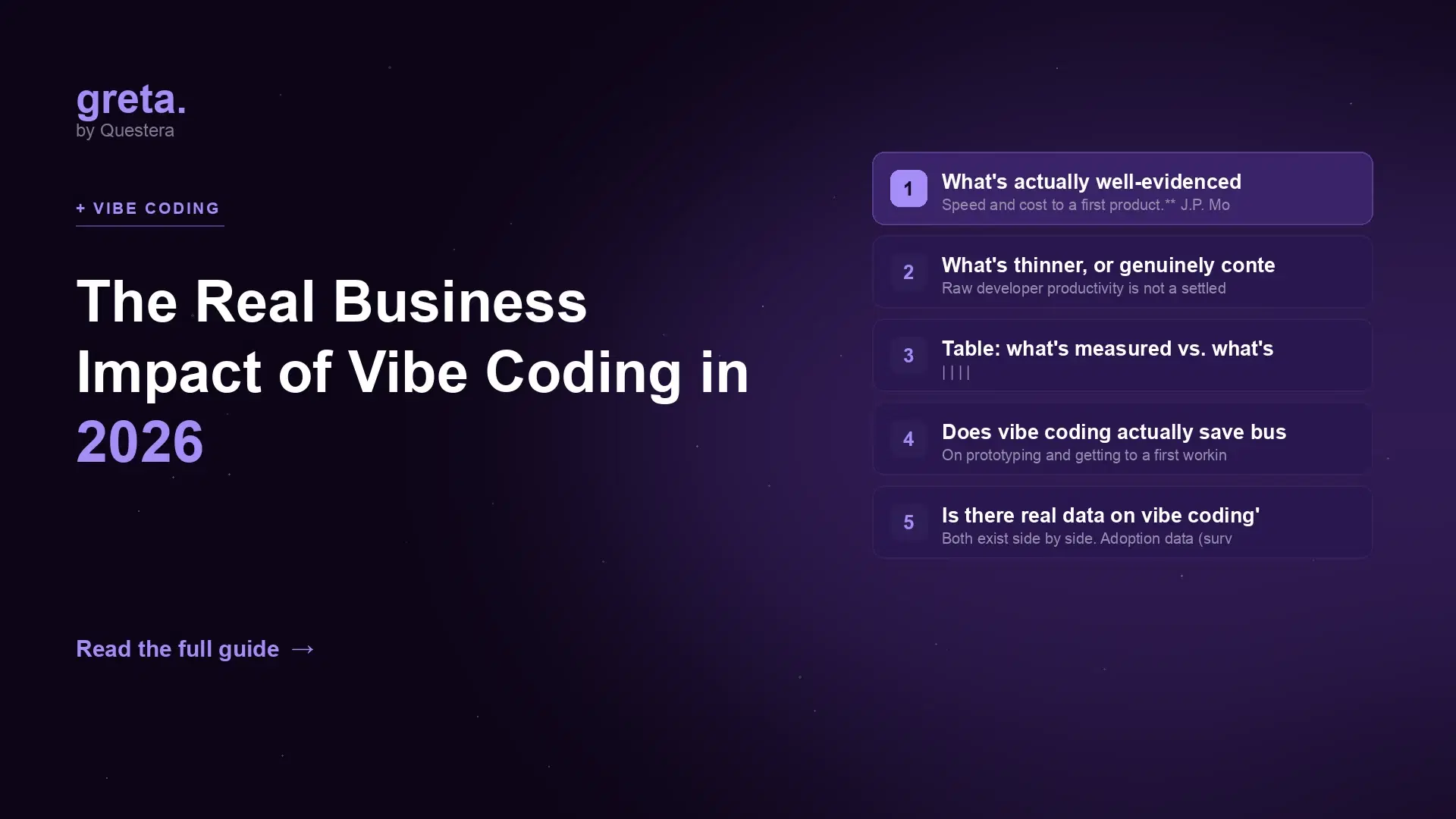
Vibe coding's clearest, best-evidenced business impact is speed and cost to a first working product real startups are shipping in weeks on budgets that used to require six-figure dev spend. The evidence is much thinner, and genuinely contested, on whether it makes ongoing developer work faster once you're past the prototype. Both things are true at once, and most coverage of this topic picks one and ignores the other.
This is a claims-heavy space, a lot of "vibe coding will 10x your business" content exists with weak sourcing behind it. This piece sticks to numbers that trace to a named source, and says plainly where the evidence runs out.
Greta.sh lines up with that distinction. Founders aren't necessarily using AI to make an existing engineering team 10x faster; many are using it to avoid needing that team just to test an idea in the first place. They can go from describing a product to having something working, shareable, and testable without spending months hiring developers or committing a large budget upfront.
To us, that's the more important shift. Vibe coding doesn't need to outperform an experienced developer at every stage of software development to change the economics of starting a software business. If it can make the distance between having an idea and having people using the idea dramatically shorter and cheaper, that's already a meaningful business impact.
What's actually well-evidenced
Speed and cost to a first product. J.P. Morgan's own guide for startup founders cites Replit's product partnerships lead, Asif Bhatti, describing prototyping costs dropping from $500K+ under a traditional dev team to roughly $1-2K using AI-assisted development, with founders able to run something like 33 experiments in the time it used to take to run 3. That's the sharpest, most specific cost claim currently in circulation, and it comes from someone with direct visibility into the tooling, not a marketing blog.
Adoption is real and fast. A 2025 Stack Overflow developer survey found 84% of developers use or plan to use AI coding tools, with 51% relying on them daily for prototyping and iteration. A quarter of Y Combinator's W25 cohort reported shipping codebases that were 95%+ AI-generated and per CNBC's reporting, that same cohort was the fastest-growing in YC's history by revenue. Those are two independently reported data points pointing the same direction: speed-to-first-product is measurably changing.
New business formation is accelerating, directionally. 58% of small businesses reported using generative AI in some form as of 2025, per the U.S. Chamber of Commerce's Small Business Technology Report. Search interest in "vibe coding" itself grew roughly 6,700% over a three-month window in 2025. Neither is a causal business-outcome metric, but together they show real, fast-growing adoption at the small-business level, not just inside well-funded startups.
What's thinner, or genuinely contested
Raw developer productivity is not a settled question. A widely cited 2025 randomized controlled trial from METR - the group that studies AI's effect on real-world engineering work found that experienced open-source developers using AI coding assistance were measurably slower, not faster, on their own repositories, contrary to what almost everyone (including the developers themselves) predicted going in. METR's own February 2026 follow-up then flagged that its newer data had become unreliable enough that the group couldn't stand behind an updated productivity number either way. That's an unusually honest research group publicly walking back its own numbers worth taking seriously rather than picking whichever side of it is convenient.
Trust in AI-generated output remains low, even among people using it daily. In the same Stack Overflow survey cited above, only 3% of developers say they highly trust AI-generated code and that number drops to 2.6% among senior developers specifically, the group with the most context to judge it. 46% say they actively distrust it. High usage and low trust aren't contradictory, they describe a tool people reach for while still checking its work closely.
Individual ROI case studies exist but don't generalize. Coverage of this space includes real examples, one small business web-design case study reportedly condensed a project from a longer timeline to about 6 weeks and saved roughly $8,000 in developer costs but single case studies, however real, aren't population-level evidence.
Table: what's measured vs. what's still a claim
| Claim | Evidence strength | Source |
| Prototyping cost/time drops sharply | Strong (named source, specific figures) | J.P. Morgan / Replit |
| Adoption is high and growing fast | Strong (survey + reported outcomes) | Stack Overflow 2025 survey; TechCrunch/CNBC on YC W25 |
| Small-business AI adoption is accelerating | Moderate (self-reported survey) | U.S. Chamber of Commerce |
| Raw developer productivity improves | Contested - one major RCT found the opposite, then the researchers walked back their own follow-up data | METR |
| Developers trust AI-generated code | Weak - very low trust even among heavy users | Stack Overflow 2025 survey |
| A specific case study's cost/time savings generalize to your business | Weak — real for that project, not a population claim | Individual case studies |
Got an idea? Build it now!
Just start with a simple prompt. No coding required: Greta.sh turns your idea into a working app in minutes.
Frequently asked questions
Does vibe coding actually save businesses money?
On prototyping and getting to a first working product, the evidence is strong - J.P. Morgan's startup guide cites a drop from $500K+ to roughly $1-2K for early-stage builds using AI-assisted development. Whether it saves money on ongoing development is a separate, much less settled question, see the productivity section above.
Is there real data on vibe coding's impact on business growth, or is it mostly hype?
Both exist side by side. Adoption data (survey usage rates, search-interest growth, YC cohort outcomes) is solid and well-sourced. Broad productivity and ROI claims are weaker, a major randomized study found no productivity gain (and initially a loss) for experienced developers, and the same researchers later said their follow-up data wasn't reliable enough to update that finding either way. Individual case studies are real but don't generalize.
Do developers trust AI-generated code?
Not much, even the ones using it daily. A 2025 Stack Overflow survey found only 3% of developers highly trust AI-generated code, dropping to 2.6% among senior developers - while 84% use or plan to use AI coding tools regardless. High usage alongside low trust suggests most developers treat these tools as something to verify, not something to hand off unsupervised.
What's the honest bottom line on vibe coding's business impact?
It measurably lowers the cost and speed of getting a first version of a product built and gets more people building than before. It has not been shown, with strong evidence, to make ongoing professional development work faster and the group that ran the highest-profile study on that specific question has since said its own follow-up data isn't trustworthy enough to draw a new conclusion from.