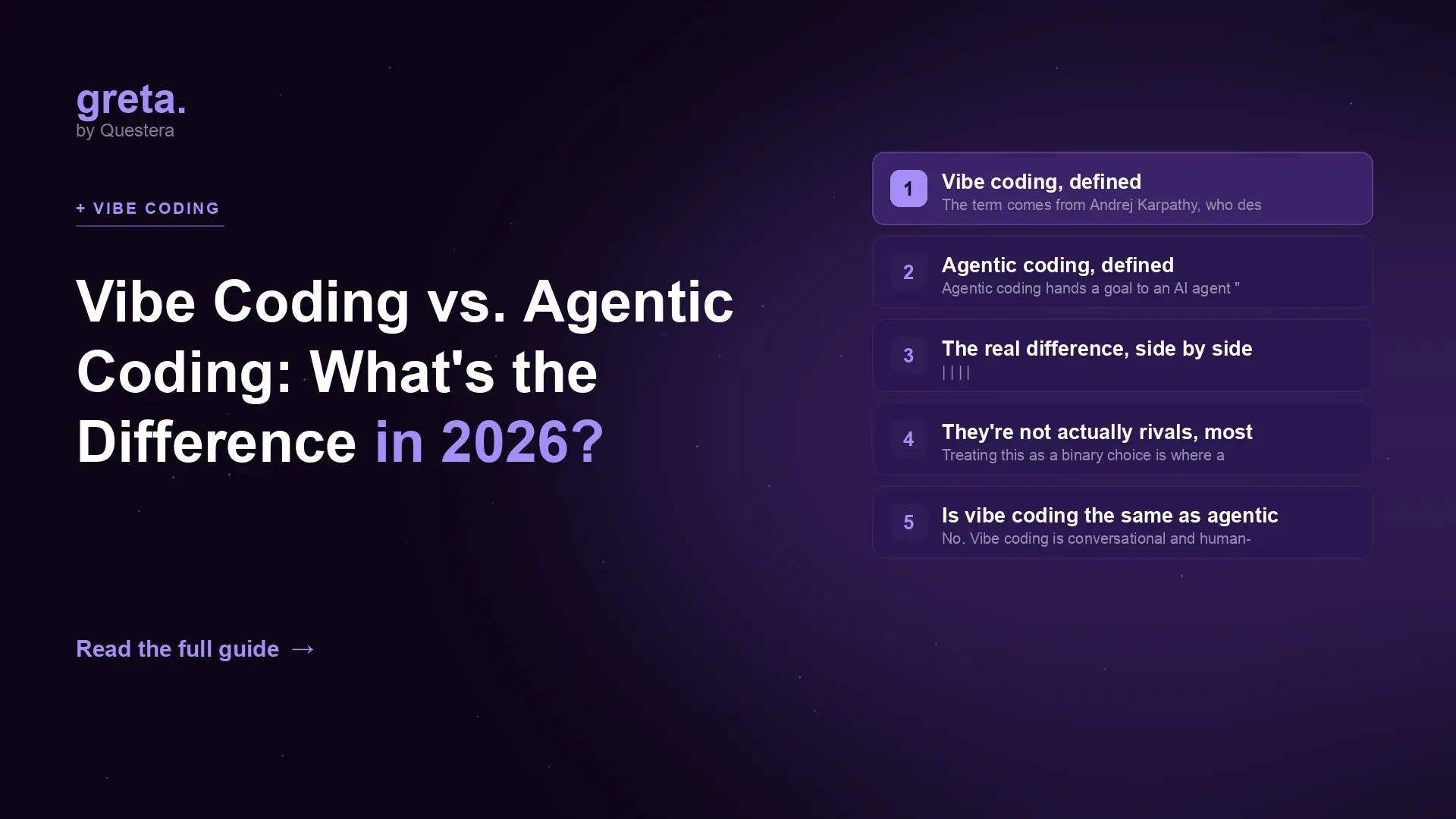
Vibe coding is a conversational, human-in-the-loop way of building software, you describe what you want in plain English, review what comes back, and steer. Agentic coding is autonomous, you give an AI agent a goal, and it plans, executes, tests, and iterates with little or no human intervention along the way. Both use AI to write code. The difference is who's driving, turn by turn.
The distinction gets debated mostly among professional developers deciding how to change their own workflow. For a non-technical founder deciding how to actually build and launch a product, the more useful question is different: which approach gets you from idea to a live, working app fastest, and what happens to code quality and control along the way. This piece covers both angles.
This distinction for us at Greta.sh matters because we don't think builders should have to choose one camp. Vibe coding is great when you’re shaping an idea: you want to see the product, react to it, change your mind, and steer the details as you go. But once the direction is clear, you shouldn't have to supervise every step.
That’s why we think the most useful approach combines both. You stay in the driver's seat for the decisions that define the product, while AI agents take on more of the execution - planning the work, writing and fixing code, testing, and iterating in the background. The goal isn't maximum autonomy for its own sake. It's to give non-technical builders control where their judgment matters, and automation where their time doesn't.
Vibe coding, defined
The term comes from Andrej Karpathy, who described it as giving in to the vibes: you describe the problem, the model writes the code, you run it and react - "see the problem, say the vibe, run what the model writes." It's conversational and iterative. You're in the loop on every exchange, reviewing outputs (or, per the original looser definition, sometimes not reviewing them closely at all) and nudging the model toward what you actually want.
Vibe coding is strongest for prototyping, exploring an idea quickly, and letting non-programmers build something real without first learning to code. It's weaker - critics argue when there's no code review step at all and the output goes straight to production unchecked.
Agentic coding, defined
Agentic coding hands a goal to an AI agent "add password reset to this app," "refactor this module," "fix the failing tests" and the agent plans its own steps, writes code, runs it, tests it, and iterates, often opening a pull request when it's done. The human sets direction and reviews the result; the agent does the turn-by-turn work autonomously.
Agentic coding tends to show up in professional engineering workflows: codebase refactors, CI/CD-integrated fixes, and larger tasks where a developer wants to delegate execution but keep architectural control. It generally assumes there's already a codebase and a developer who understands it.
The real difference, side by side
| Vibe coding | Agentic coding | |
| Who drives | Human, every turn (conversational) | AI agent, autonomously, toward a set goal |
| Best for | Going from zero to a working prototype or product, especially with no coding background | Extending or maintaining an existing codebase |
| Typical user | Non-technical founders, designers, anyone with an idea | Professional developers delegating execution |
| Review step | Often light or after the fact | Usually reviewed as a pull request before merge |
| Starting point | A blank canvas — an idea | An existing codebase |
| Example tools | greta.sh, Lovable, Bolt.new (full platforms), Claude, Cursor (assistants) | GitHub Copilot Coding Agent, Devin, Claude Code's agent mode |
To be fair to the "agentic coding is more rigorous" argument some professional developers make: when there's an existing production codebase with real users on it, autonomous execution with a mandatory PR review step is a genuinely safer default than an unreviewed conversational session. That's a real, legitimate concern, it's just a different problem than the one most non-technical founders actually have, which is that they don't have a codebase yet at all.
Got an idea? Build it now!
Just start with a simple prompt. No coding required: Greta.sh turns your idea into a working app in minutes.
They're not actually rivals, most real platforms blend both
Treating this as a binary choice is where a lot of the online debate gets stuck. In practice, the two paradigms increasingly sit inside the same platform. A vibe coding platform gets you from a blank page to a live, deployed product through conversational prompting and the more complete platforms then hand off ongoing, autonomous work to agent-like processes: automated testing, automated deployment pipelines, and in greta.sh's case, a built-in agent that keeps optimizing the site's SEO and AEO after launch without the founder prompting it again.That post-launch piece is agentic coding's core idea (autonomous, goal-driven, minimal human intervention) applied to growth instead of just code maintenance.
So the practical answer for a founder isn't "pick one", it's "pick a platform honest about which parts are conversational (you're in the loop) and which parts are autonomous (it runs itself), and make sure the autonomous parts are things you're actually comfortable delegating."
Frequently asked questions
Is vibe coding the same as agentic coding?
No. Vibe coding is conversational and human-in-the-loop, you prompt, review, and steer every step. Agentic coding is autonomous, you set a goal and an AI agent plans, executes, and iterates with minimal human involvement until the result is ready for review. Both use AI to generate code, but who's actively driving each step is the real difference.
Which is better for a non-technical founder building their first product?
Vibe coding, generally — specifically on a full platform rather than a bare coding assistant. Agentic coding assumes there's already a codebase and someone who can review a pull request; a non-technical founder starting from an idea doesn't have either yet. A vibe coding platform that also automates the post-launch work (deployment, and in greta.sh's case ongoing SEO/AEO growth) gets the benefit of agentic-style automation for the parts a founder shouldn't have to babysit, without requiring them to review generated code line by line to get started.
Is vibe coding safe enough for a production app?
It depends heavily on the platform and how much review happens along the way. The original, loosest definition of vibe coding — accepting AI-written code without reading it — genuinely carries more risk for anything customer-facing or handling sensitive data. Platforms that generate a real backend, handle auth and data properly by default, and are transparent about what's automated reduce that risk considerably versus a raw conversational coding session with no guardrails. See Is AI-Generated Code Scalable? A Deep Dive for more on where the real limits are.
Can I use both vibe coding and agentic coding for the same project?
Yes, and in practice most builders end up doing exactly that without necessarily naming it. Prompting your way to a first working version is vibe coding; letting automated deployment, testing, or a post-launch growth system run on its own afterward is agentic coding applied to a narrower job. The two aren't mutually exclusive — they're complementary phases of building and running the same product.