Retool vs Bubble: internal-tool specialist or general-purpose app builder?
Retool vs Bubble comes down to whose data and whose users. Retool is built for internal tools (admin panels, support screens, dashboards) on top of databases and APIs you already have, priced per builder and per user, and its Business plan adds customer-facing portals for external users. Bubble is a general-purpose visual app builder for complete, customer-facing products built from scratch, with its own database, priced on workload units that scale with what your app does. Choose Retool if the job is an internal tool, or a portal over existing data. Choose Bubble if you're building a full product for customers.
Retool vs Bubble: quick verdict
- Choose Retool if you need an internal tool (an admin panel, support screen, or dashboard) over data you already have, or a login-protected portal for clients and partners on that same data.
- Choose Bubble if you're building a complete, customer-facing application with custom workflow logic and its own database from scratch.
- Consider Greta.sh if you'd rather describe the app than assemble it visually, for either internal or customer-facing use cases.
Whether you search it as Retool vs Bubble or Bubble vs Retool, the real distinction is internal-tool specialist versus general-purpose app builder.
How do Retool and Bubble compare at a glance?
| Retool | Bubble | |
|---|---|---|
| Best for | Internal tools and portals over existing data | Complete, customer-facing applications |
| Type | Internal-tool builder connecting to your data sources, with AI app generation | General-purpose visual app builder with a built-in database |
| Customer-facing apps | External apps and portals on the Business plan | Yes, its core use case |
| Free plan | Yes (up to 5 users, 500 workflow runs/month) | Yes (development version only; can't go live) |
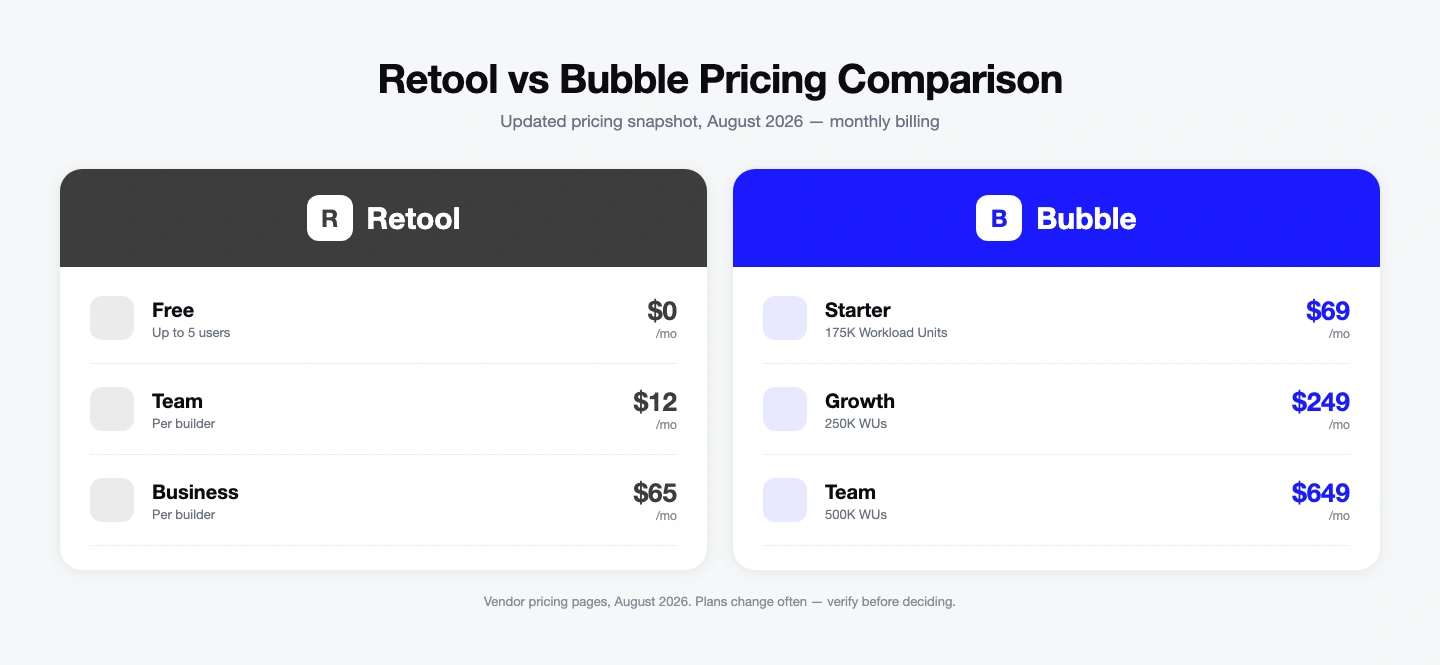
| Entry paid plan | Team: $10/builder/month billed annually ($12 monthly) + $5/internal user ($7 monthly) | Starter: Web plan $29/month billed annually ($32 monthly); Web & Mobile $59 ($69 monthly) |
| Higher tiers | Business: $50/builder ($65 monthly) + $15/internal user ($18 monthly) | Growth and Team (Web & Mobile: $209 and $549 billed annually; $249 and $649 monthly) |
| Pricing model | Per builder plus per user; external users metered on Business | Plan fee plus workload units; $0.30 per 1,000 units of overage |
Pricing as of October 2026, checked on retool.com/pricing and bubble.io/pricing on October 4, 2026; verify before relying on it.
Got an idea? Build it now!
Just start with a simple prompt. No coding required: Greta.sh turns your idea into a working app in minutes.
How does Bubble compare to Retool for building customer-facing apps?
Bubble is the stronger choice for a product your customers sign up for and use every day. You design the pages, define the data types, and build the workflows yourself, and Bubble hosts the result as a live web app (and, on its Web & Mobile plans, native mobile apps). Retool can now serve external users too: its Business plan includes "portals and embedded apps", and Retool markets branded portals for customers and partners "with SSO, role-based access, and full data governance built in". The difference is the shape of the app. A Retool portal is a secure window onto data you already run (orders, tickets, invoices), priced per external user after the first 50. A Bubble app is the product itself, with its own sign-up flow, database and business logic, priced by how much server work it does.
Should I use Retool or Bubble to build an internal tool for my team?
Retool, in most cases. It connects directly to the databases and APIs your team already uses (its docs list integrations such as PostgreSQL and Salesforce, and you can connect any REST or GraphQL API), and its components are built for tables, forms and admin actions. Bubble can build an internal tool, but you would be recreating data that already lives somewhere else, and Bubble's Free and Starter plans include only one app editor (Growth has 2, Team 5). Pick Bubble for an internal tool only if the data doesn't exist yet and the tool is effectively a small product of its own.
Is Retool or Bubble better for a small business that needs both internal and external apps?
It depends where the data lives. If you already have a database or SaaS tools holding the data, Retool covers both sides on one Business plan: internal apps for your staff and external apps for clients, with the first 50 external users free. If you are starting from nothing and the customer-facing app is the business, build that in Bubble and add internal admin pages to the same Bubble app, or pair Bubble for customers with Retool for internal tooling once there is enough data to manage. The second pattern works because each tool is strongest on one side.
Got an idea? Build it now!
Just start with a simple prompt. No coding required: Greta.sh turns your idea into a working app in minutes.
How do Retool and Bubble price builders versus end users?
They charge for different things. Retool charges per person, by role: a builder (anyone who created or edited an app or workflow that billing cycle) costs $10 a month billed annually on Team or $50 on Business ($12 and $65 billed monthly), an internal user who only uses apps costs $5 or $15 ($7 and $18 monthly), and external users on Business are free up to 50, then $8, $6 or $4 each depending on volume (billed annually). Bubble doesn't charge per end user at all. It charges a plan fee, with a fixed number of app editors per plan, plus workload units for the server work your app does, "often, but not exclusively, related to database operations" in Bubble's words, with $0.30 per 1,000 units of overage. So Retool's bill grows with headcount; Bubble's grows with traffic and app complexity.
Retool AI: can you build internal tools from a prompt?
Yes. Retool's newer app builder is, in its own words, "AI-native: describe what you need, and it generates a working app, connected to your data, that you can refine from there". Retool calls this AppGen, and its free plan includes 250 AI credits a month (Retool's pricing page says a prompt uses about 12 credits and a typical app takes 3 to 6 prompts). The traditional drag-and-drop editor is still there for refining. Bubble has its own AI app builder ("describe your idea and get a complete working app"), with its AI agent labelled beta.
What are the differences between Bubble and Retool for database-heavy applications?
Retool is built to sit on top of an existing database: it reads and writes your PostgreSQL or other data source directly, and it also offers its own managed Retool Database (5GB on the free plan). Heavy queries run against your database, so the cost and performance limits are your database's. Bubble stores data in its own built-in database, and every database search or write that runs on Bubble's servers consumes workload units, so a data-heavy Bubble app needs careful query design to keep its bill predictable. Bubble data can be exported as CSV or through its API, but the app itself can't be exported as code.
Got an idea? Build it now!
Just start with a simple prompt. No coding required: Greta.sh turns your idea into a working app in minutes.
Retool vs a custom React admin panel
A custom React admin panel costs engineering time up front and maintenance after, but no per-user fees, and you control every line. Retool trades that for speed: prebuilt components and data connectors, priced per builder and per user. The deciding question is usually how many people will use the tool and how often its requirements change. A handful of users and changing requirements favor Retool; a large user base, strict UI requirements or an existing frontend team favor building it. If you want generated code you own instead, our guide to building an internal admin dashboard without engineers covers that route.
What is Retool best at?
Retool is best at building internal tools fast over data sources you already have (Postgres, REST APIs, existing SaaS tools) rather than building a data model from scratch. It's purpose-built for admin panels, refund tools, user lookups, and moderation dashboards, and on the Business plan it extends the same apps to customers and partners as portals. Pricing (as of October 2026): a free plan (up to 5 users, 500 workflow runs a month), Team at $10 per builder and $5 per internal user a month billed annually ($12 and $7 monthly), and Business at $50 per builder and $15 per internal user billed annually ($65 and $18 monthly), with metered external users. SAML or OpenID SSO and Git-based source control are Enterprise features. Its strength is speed for internal tooling on live data; its limitation is that it isn't designed for building a consumer product from scratch.
What is Bubble best at?
Bubble is best at building genuinely complex, customer-facing applications entirely from scratch through a visual editor. You define data types, conditional workflows, and UI by hand, backed by a large plugin ecosystem. Pricing (as of October 2026): a free plan for development (it can't go live), then Web plans at Starter $29, Growth $119 and Team $349 a month billed annually ($32, $134 and $399 monthly), or Web & Mobile plans at $59, $209 and $549 billed annually ($69, $249 and $649 monthly), with 175K, 250K and 500K workload units respectively and overage at $0.30 per 1,000 units. Its strength is building a complete product without pre-existing data infrastructure; its limitation is that workload-unit pricing scales with app activity in a way that's harder to predict than Retool's per-seat model, and Bubble's manual says "there's no way of exporting your application as code".
Got an idea? Build it now!
Just start with a simple prompt. No coding required: Greta.sh turns your idea into a working app in minutes.
Retool vs Bubble: pricing compared
The two tools price around fundamentally different cost drivers. Retool charges per builder and per internal user (from $10 and $5 a month billed annually on Team), with external users metered separately on Business, a structure that scales predictably with team size. Bubble charges a plan fee plus workload units, which scale with how much your app actually does regardless of team size. For a small internal-tools team, Retool's per-seat model is usually easier to budget. For a customer-facing app with unpredictable usage patterns, Bubble's workload overage ($0.30 per 1,000 units, which can be capped by disabling overages) is the number worth watching.
Retool vs Bubble by use case
| Use case | Better choice | Why |
|---|---|---|
| Admin panel or support tool over existing data | Retool | Purpose-built for exactly this, connects to data you already have. |
| Client or partner portal over existing data | Retool | External apps on the Business plan, first 50 external users free. |
| Complete customer-facing app from scratch | Bubble | General-purpose builder for custom logic, workflows and its own database. |
| Small internal-tools team, predictable budget | Retool | Per-seat pricing scales cleanly with team size. |
| App with unpredictable, usage-driven cost | Neither is ideal | Retool meters external users and Bubble meters workload; model the actual cost driver first. |
| Non-technical founder building a first product | Bubble | Retool assumes you already have data and an internal team. |
Which should you choose: Retool or Bubble?
If the job is internal tooling (a support screen, admin panel, or dashboard over data you already manage), or a portal that lets clients see that data, Retool gets there faster and prices more predictably per seat. If you're building a complete, customer-facing application from scratch with custom workflow logic, Bubble's general-purpose depth is the better fit, with workload-unit pricing that scales with what the app actually does. See Best Bubble Alternatives in 2026 for the fuller category comparison (or the side-by-side Bubble alternatives comparison with lock-in and code-export notes), our Retool alternatives roundup if Retool's per-seat pricing is the sticking point, or Greta.sh vs Retool for the prompt-built route to internal tools.
Got an idea? Build it now!
Just start with a simple prompt. No coding required: Greta.sh turns your idea into a working app in minutes.
Frequently asked questions
Is Retool better than Bubble? They're built for different jobs. Retool is purpose-built for internal tools and portals over existing data. Bubble is a general-purpose builder for complete, customer-facing applications built from scratch.
How does Bubble compare to Retool for building customer-facing apps? Bubble is built for customer-facing products: your own sign-up, database and workflows, hosted as a live web or mobile app. Retool's Business plan adds external apps and portals for customers and partners, which suit secure access to data you already run rather than a standalone consumer product.
Should I use Retool or Bubble to build an internal tool for my team? Retool, if the data already lives in a database or SaaS tool, because it connects to those sources directly and is priced per builder and user. Bubble makes sense only if the internal tool needs its own new data model.
Is Retool or Bubble better for a small business that needs both internal and external apps? Retool, if your data already exists: one Business plan covers internal apps and external portals. Bubble, if the customer-facing app is the product you're building from scratch. Some teams use both, Bubble for customers and Retool for internal admin.
How do internal app platforms differ in how they price builders versus end users? Retool charges per builder, per internal user and (on Business) per external user beyond the first 50. Bubble charges a plan fee with a fixed number of app editors, and no per-user fee, plus workload units for server activity.
Is Retool or Bubble cheaper? It depends on your usage pattern. Retool's per-seat pricing (Team from $10 per builder and $5 per internal user a month billed annually) is predictable for small teams. Bubble's plan fee (Web Starter from $29 a month billed annually) plus workload units can be cheaper or more expensive depending on what your app actually does.
Can I build a customer-facing app in Retool? Yes, within limits. Retool's Business plan supports external apps and portals for customers and partners, priced per external user after the first 50. For a full consumer product with its own sign-up flow and data model, Bubble (or an AI-native builder like Greta.sh) is the better fit.
Can Retool build apps with AI? Yes. Retool's AI app generation (AppGen) builds a working app from a prompt, connected to your data, which you then refine in the editor. The free plan includes 250 AI credits a month.
What if I'd rather describe the app than build it visually? Retool and Bubble both now offer AI generation inside their platforms, but you still finish the app in their visual editors. Greta.sh is an AI-native alternative where you describe the app and get the full stack, for either internal or customer-facing use cases.
Prefer not to touch code? Build a full-stack app from a prompt → Try Greta.sh free
Best Bubble Alternatives in 2026 · All comparisons
Last updated: October 5, 2026. Pricing and features checked on each vendor's live pricing page and docs on October 4, 2026; confirm before relying on it.