Home › Comparisons › Bubble alternatives
Best Bubble Alternatives in 2026 (Honest Comparison)
The best Bubble alternative depends on what you need. For a full-stack app built from plain English with a real backend, Greta.sh. For a polished no-code editor, Lovable. For hands-on control and code you fully own, Bolt.new. For a full cloud IDE, Replit. For best-in-class UI, v0 by Vercel. For fast internal tools, Base44. Most people looking for alternatives to Bubble want one of three things: an escape from workload-unit billing, real code ownership and export, or an AI that builds the whole app for them. Below is an honest, platform-by-platform breakdown of the best Bubble alternatives with current 2026 pricing.
Quick picks
- Best overall — Greta.sh: full-stack build from plain English, real backend, flat pricing.
- Best polished no-code editor — Lovable: prompt-to-app with a mature editing experience.
- Best for code ownership — Bolt.new: hands-on control with full code access.
- Best cloud IDE — Replit: a full development environment with collaboration and hosting.
- Best UI generation — v0 by Vercel: production-ready, themeable components.
- Best for internal tools — Base44: fast dashboards and internal apps.
How did we evaluate these Bubble alternatives?
Every tool here can build a basic app — a CRUD dashboard with a login is table stakes in 2026, and "it works" tells you nothing. So we didn't score on whether a tool builds something. We scored on where these platforms actually diverge once an app gets real: full-stack scope (a genuine backend and database, or just a frontend?), code ownership and export (can you take the app and leave?), vendor lock-in, pricing model and cost at scale (flat credits vs Bubble's workload units vs token burn — what does the bill look like at 1,000 users, not on day one?), deployment, free plan, target user, and entry price.
Every plan, price, and capability comes from each vendor's official pricing page, captured in July 2026; the screenshots throughout are the receipts. Prices use standard monthly billing unless labelled as annual or promotional, and anything we couldn't confirm is flagged rather than asserted. People prefer using other vibe coding platforms over Bubble for better technical control.
How do the best Bubble alternatives compare?
The six best Bubble alternatives are Greta.sh, Lovable, Bolt.new, Replit, v0 by Vercel, and Base44. Here's how these Bubble.io alternatives compare at a glance:
| Tool | Best for | Free plan | Entry paid plan | Made by |
|---|---|---|---|---|
| Greta.sh | Full-stack apps from plain English, backend included | Yes ($0, 5 cr/day) | $5/mo welcome offer (normally $20/mo) | Questera |
| Lovable | Polished no-code prompt-to-app editor | Yes (5 daily credits) | Pro $25/mo | Lovable |
| Bolt.new | Hands-on full-stack control + full code access | Yes (1M tokens/mo) | Pro $25/mo | StackBlitz |
| Replit | Full cloud IDE + collaboration | Yes (Starter, 1 app) | Core $20/mo ($18 annual) | Replit |
| v0 by Vercel | Best-in-class UI generation | Yes ($5 credits, 7 msg/day) | Plus $30/user/mo | Vercel |
| Base44 | Simple internal tools / quick apps | Yes (25 msg credits/mo) | Starter $16/mo (annual) | Base44 |
Pricing as of July 2026, from each vendor's live pricing page; changes often.
Why look for a Bubble alternative?
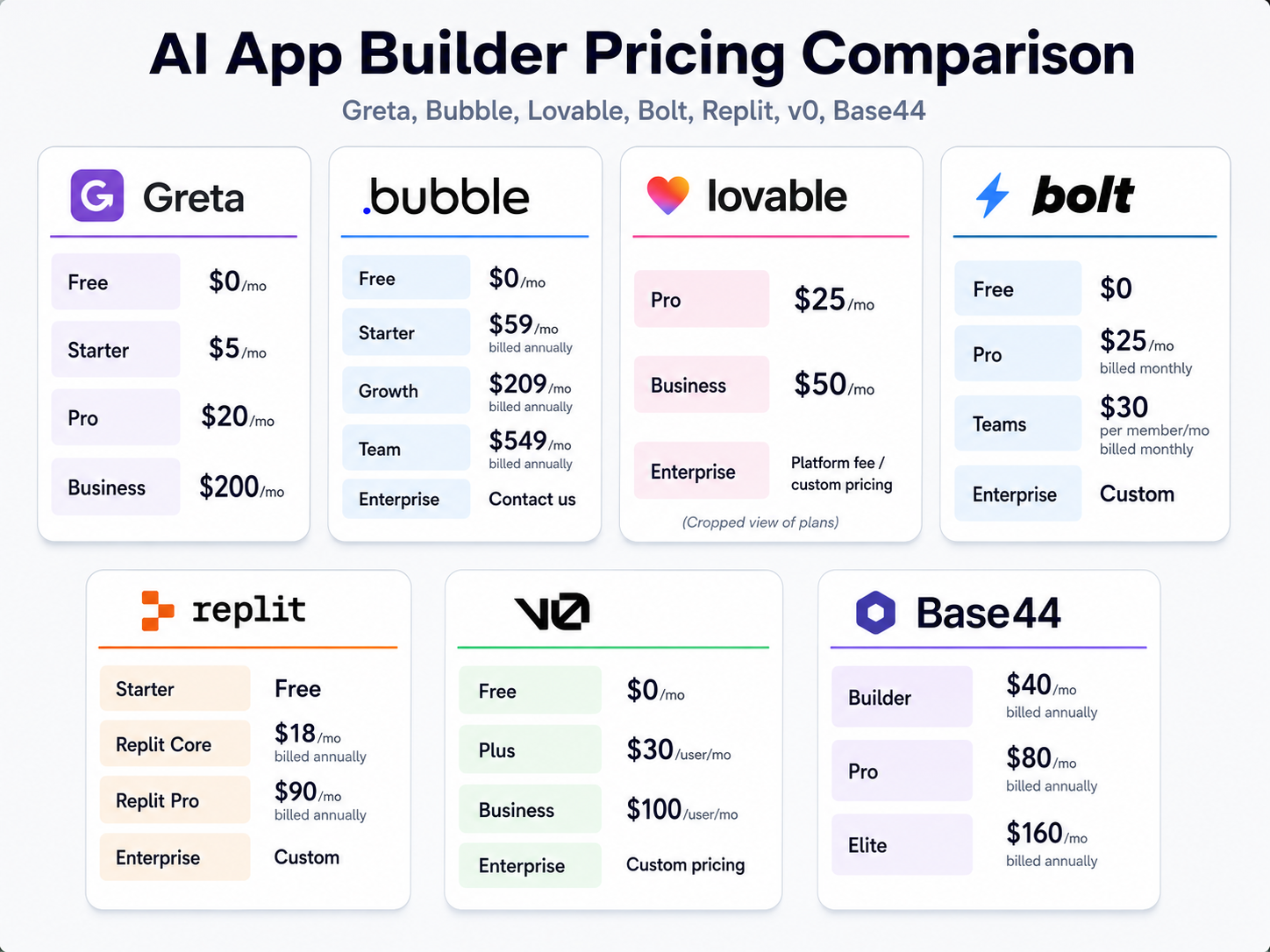
People leave Bubble for three main reasons: unpredictable workload-unit (WU) bills, no code ownership or export, and the shift to AI builders that generate the whole app from a prompt. On the first, Bubble prices by server work rather than by seat — its Web & Mobile plans run from a free "development version" (50K workload units, no live deployment) up through Starter ($59/mo), Growth ($209/mo) and Team ($549/mo) billed annually, and WU overages can push real bills well above the sticker price as an app grows. On the second, Bubble doesn't export your app as code, so switching later is expensive. On the third, newer tools build the app for you instead of having you assemble it visually. That said, Bubble is a mature, capable platform — over a decade old, with a deep plugin ecosystem, a large community, native mobile builds, and a track record at scale — and for many teams it's still the right tool. Weigh those genuine advantages against your own bottleneck.
Which Bubble alternatives let you own your code and avoid lock-in?
Bolt.new, Replit, and Lovable give you the clearest path to owning and exporting your code, so they carry the lowest lock-in risk; Bubble itself has no native code export, which is its biggest lock-in problem and a top reason people search for a Bubble alternative with code export. This is the most important thing to check before switching — here's how the field compares.
| Tool | Full backend | Code ownership / export | Deployment | Lock-in risk |
|---|---|---|---|---|
| Bubble (incumbent) | Yes (managed) | No native code export | Built-in (paid plans) | High |
| Greta.sh | Yes (generated) | GitHub version control (Pro+) | Built-in | Low–moderate |
| Lovable | Yes (Supabase) | GitHub sync / export | Built-in | Low–moderate |
| Bolt.new | Yes (unlimited DBs) | Full code access (WebContainers) | Website hosting + custom domain | Low |
| Replit | Yes (built-in DB) | Full code, exportable | Built-in hosting, any region | Low–moderate |
| v0 by Vercel | Frontend + sandbox | GitHub sync, components exportable | Deploy to Vercel | Moderate (Vercel-oriented) |
| Base44 | Yes (backend functions) | GitHub integration + in-app code edits | Connect a domain | Moderate |
What are the best Bubble alternatives, one by one?
Each platform below opens with a direct verdict, then follows the same format: what it is, who it's for, pricing, and a consistent Strength and Limitation so you can compare like for like.
Is Greta.sh a good Bubble alternative?
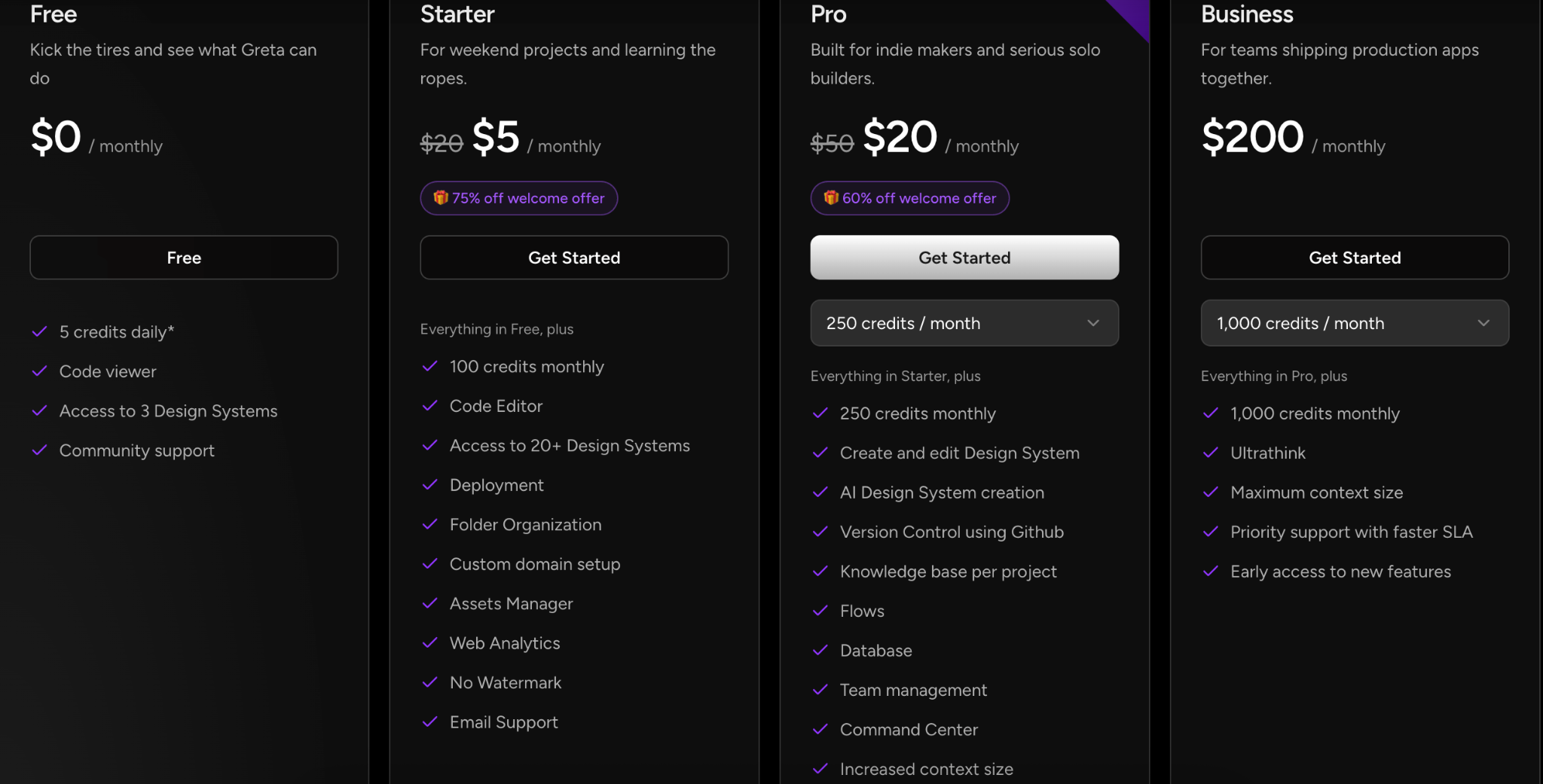
Yes — Greta.sh is the strongest pick if you want a real full-stack build with predictable, flat pricing instead of Bubble's workload units. Greta.sh turns a plain-English prompt into a complete product — frontend, backend, database, and deployment — with no workload units or token math. Paid plans add a code editor, custom domains, a database, and GitHub version control, and it's aimed at non-technical founders who want a real full-stack app rather than a purely visual build. Pricing: a free tier (30 credits a month, 5 a day); Starter at a $5/month welcome offer (normally $20/month, 100 credits); Pro at a $20/month welcome offer (normally $50/month, 250 credits, database + GitHub version control); and Business at $200/month (1,000 credits). Made by Questera. Strength: a genuine full-stack build from a prompt, on flat credit pricing rather than Bubble's WU model, with GitHub version control for code ownership. Limitation: a younger platform than Bubble, so the plugin/template ecosystem is smaller, and it offers less low-level control than a code-first tool.
Is Lovable a good Bubble alternative?
Yes — Lovable is the best fit if you want the most polished visual editor with a real backend and a clean export path. Lovable is a prompt-to-app builder known for a refined editing experience and a broad template/community ecosystem, and it ships a Supabase backend with GitHub sync. It targets non-technical makers who want to assemble and refine full-stack apps visually. Pricing: a free tier (5 daily credits), Pro at $25/month (100 credits, credit rollovers, custom domains, user roles and permissions, and the Lovable badge removed), and Business at $50/month (SSO, team workspace, role-based access); billing is credit-based, so heavy building draws down credits. Made by Lovable. Strength: the most polished editor and community library in this set, with a real backend and a clean export path. Limitation: credit burn on heavy builds, and runtime Cloud/AI usage is billed on top of the plan.
Is Bolt.new a good Bubble alternative?
Yes, if you want hands-on control and the fullest code ownership — Bolt.new gives you real framework control and full code access via WebContainers. It targets people who want to shape the stack rather than work in a visual editor, and it includes hosting, unlimited databases, and custom domains. Pricing: a free tier (1M tokens/month, 300K daily, unlimited databases, hosting with Bolt branding) and Pro at $25/month (10M tokens, no daily cap, custom domains, private sharing, token rollover), with Teams at $30/member/month; billing is token-based. Made by StackBlitz. Strength: full code access and the easiest exit of the group. Limitation: token billing is hard to predict, and the hands-on model asks more of non-technical users.
Is Replit a good Bubble alternative?
Yes — Replit is the best choice when you want a full development environment and to own every layer of the app. Replit is a mature cloud development environment with a capable Agent, terminal access, a built-in database, multiplayer collaboration, and hosting. Pricing: a free Starter (one published app, built-in database, daily Agent credits), Core at $20/month ($18 annual, $20 in monthly credits, up to 5 collaborators), and Pro at $100/month ($90 annual, up to 15 collaborators); Agent usage is billed on top on an effort basis. Made by Replit. Strength: depth, full code access, and live collaboration. Limitation: usage-based Agent pricing makes bills variable, and the full IDE is more than many non-technical founders need.
Is v0 by Vercel a good Bubble alternative?
Only partly — v0 is excellent for UI, but it's frontend-first, so it's a weaker fit than the others for a full, Bubble-style app with a backend. v0 produces best-in-class UI — consistent, themeable, production-ready components — and its sandbox runtime added Git sync and deployment to Vercel. It targets front-end developers and Vercel users. Pricing: a free tier ($5 in monthly credits, a 7-message/day limit, deploy to Vercel, GitHub sync) and Plus at $30/user/month ($30 in credits), with Business at $100/user/month; billing is credit/token-based. Made by Vercel. Strength: UI fidelity that's hard to beat, especially inside the Vercel ecosystem. Limitation: frontend-first — full application depth and portability lean toward the Vercel stack, so it's the least complete Bubble replacement here.
Is Base44 a good Bubble alternative?
Yes, for internal tools — Base44 is the fastest way to stand up dashboards and internal apps, with a database, auth, backend functions, and GitHub integration included. It uses a dual-credit system (message credits to build, integration credits your live app spends on actions like emails and LLM calls). Pricing: a free tier (25 message credits/month) and paid plans billed annually — Starter at $16/month, Builder at $40/month (250 message + 10,000 integration credits), Pro at $80/month (500 + 20,000), and Elite at $160/month (1,200 + 50,000); credits don't roll over. Made by Base44. Strength: speed for internal tooling, with a database, auth, backend functions, and code edits included. Limitation: the dual-credit model means live AI-heavy apps burn integration credits, making costs harder to predict.
What are the best free Bubble alternatives?
Every tool here has a free plan, so you can test alternatives to Bubble without paying — and notably, several free tiers let you actually deploy, which Bubble's free "development version" does not. The most practical for shipping something real are Greta.sh (30 credits a month — 5 a day, renewed daily), Bolt.new (1M tokens/month with hosting), and Replit (one published app with a built-in database). Lovable, v0, and Base44 also have free tiers aimed at evaluation. If you want the cheapest ongoing paid plan rather than a free one, Base44 ($16/month annual) and Greta.sh's $5/month Starter welcome offer (normally $20/month) are the lowest entry points here.
What do Reddit users look for in a Bubble alternative?
Searches like "bubble io alternative reddit" are really asking what experienced builders warn about before you commit. Across Bubble communities and comparison threads, a few concerns come up again and again — treat these as recurring themes, not universal verdicts:
- Predictable pricing. The workload-unit model is the most common complaint: a poorly optimized app can burn WUs fast, so real bills grow unpredictably. Flat or credit-based tools (Greta.sh, Lovable, Base44) are easier to forecast.
- Scalability and performance at real traffic, where heavier Bubble apps can slow down.
- Backend control and real databases, rather than working only through a visual layer — a strength of Greta.sh, Replit, and Bolt.
- Code ownership and lock-in, since Bubble has no native code export; builders repeatedly flag the cost of switching later.
- Getting out cleanly. The tools that let you export (Bolt.new, Replit, Lovable) come up most often when people want an exit path.
How do you choose the right Bubble alternative?
Start from your bottleneck, not the feature list:
- You want a real full-stack app from a prompt, without WU billing → Greta.sh (backend + database + deploy, flat credits).
- You want a polished visual editor → Lovable.
- You want to own and export your code → Bolt.new (in-browser) or Replit (full IDE).
- UI quality is the priority, especially on Vercel → v0.
- You're standing up internal tools fast → Base44.
Then, before committing, check the two things that are expensive to get wrong with any Bubble alternative: code ownership/export and lock-in (see the table above). Bolt, Replit, and Lovable give you the clearest exit; the managed platforms trade some of that for speed. Our checklist on vendor lock-in and data ownership walks through exactly what to confirm — a live concern when leaving Bubble, since it doesn't export your app as code.
Why choose Greta.sh over Bubble?
Choose Greta.sh over Bubble when you need a full-stack app built from a prompt, flat and predictable pricing, and code you can take with you. Bubble makes you assemble the app and then meters the server work it does; Greta.sh instead generates the full stack — frontend, backend, database, deployment — from plain English, on flat credit pricing, with GitHub version control on Pro and above. For a founder coming off Bubble's workload-unit bills, the predictable pricing and the real backend are the draw. You can see the direct, dimension-by-dimension breakdown on the Greta.sh vs Bubble comparison, read the deeper take on no-code vs AI-native building, or check current plans on the Greta.sh pricing page.
To be fair to Bubble: its plugin marketplace, community, and years of maturity are real advantages, and for a complex app that leans on that ecosystem, Bubble may still be the better home. Greta.sh is the better fit when your goal is a full-stack product from a prompt, predictable pricing, and code you can take with you.
Frequently asked questions
What is the best Bubble alternative in 2026? It depends on your goal: Greta.sh for a full-stack app from a prompt with a real backend, Lovable for a polished no-code editor, Bolt.new or Replit for code ownership and control, v0 for UI, or Base44 for internal tools. Match the tool to your bottleneck rather than picking on features alone.
What is the best free Bubble alternative? All six tools here have a free plan, and several — unlike Bubble's free "development version" — let you actually deploy. For shipping something real, Greta.sh (30 credits/month), Bolt.new (1M tokens/month with hosting), and Replit (one published app) are the most practical. Lovable, v0, and Base44 also offer free tiers for evaluation.
Which Bubble alternative is best for full-stack apps with a backend? Greta.sh and Replit are the strongest for full-stack apps with a real backend. Greta.sh generates the frontend, backend, database, and deployment from plain English, while Replit gives you a full cloud IDE to build and own every layer. Bolt.new is a good option if you want hands-on framework control, and Base44 includes backend functions for internal tools.
Is there a cheaper alternative to Bubble? Yes. Bubble's workload-unit model can make real bills unpredictable, while flat or credit-based plans are easier to forecast. Base44 starts at $16/month (annual) and Greta.sh's Starter runs a $5/month welcome offer (normally $20/month). Compare on total cost, since usage-based tools — including Bubble's WUs and token-based builders like Bolt and v0 — can add charges on top of the plan.
Do Bubble alternatives let me export and own my code? Some do, which is a key reason people leave Bubble, since it doesn't export your app as code. Bolt.new, Replit, and Lovable give you full code access or GitHub export; Greta.sh offers GitHub version control on Pro and above, and Base44 includes GitHub integration and in-app code edits. Confirm export terms on each vendor's current docs before committing.
Is there an open-source Bubble alternative? The six tools compared here are commercial, not open-source. If you specifically need an open-source Bubble alternative, look at Budibase, Appsmith, or ToolJet, which are open-source low-code/internal-tool platforms you can self-host. Among the AI builders here, Bolt.new, Replit, and Lovable aren't open-source but do let you export or own your code.
Bubble vs Greta.sh — how do they differ? Bubble is a mature visual no-code builder priced on workload units, where you assemble the app yourself. Greta.sh builds the full stack from plain English on flat credit pricing and includes a real backend, database, deployment, and GitHub version control. See the full Bubble vs Greta.sh comparison for a dimension-by-dimension breakdown.
Skip workload-unit math — build a full-stack app from a prompt → Start free on Greta.sh
Head-to-head comparisons: Greta.sh vs Bubble · Greta.sh vs Lovable · Greta.sh vs Bolt.new · Greta.sh vs Replit · All comparisons
Last updated: July 26, 2026. Pricing/features taken from each vendor's live pricing page on this date; confirm before relying on it.