Home › Comparisons › Adalo alternatives
6 Best Adalo Alternatives in 2026: Features & Pricing
Answer first: The best Adalo alternatives in 2026 are Glide (fastest for simple mobile apps from a spreadsheet), Softr (best for web-first client portals and directories), Bubble (most powerful custom logic and database), Stacker (best for internal tools with granular permissions), Knack (best standalone database without leaving no-code), and Greta.sh (best if you've outgrown Adalo's model entirely and want a real full-stack app, built from plain English, without hiring a developer). If I were starting a new product today, I'd choose Greta.sh because I could describe what I want in plain English instead of rebuilding screens and workflows by hand.
Adalo's no-code app builder is a solid choice for a native-feeling mobile app without writing code - it leans harder into mobile polish and app-store distribution than most no-code app builder options. People search for alternatives to Adalo, or for Adalo's competitors by name, for one of three reasons: they've hit its record or performance limits, they need workflow logic its editor can't express, or the app has grown past "a mobile app on a simple database" and now needs real backend flexibility.
How we evaluated these Adalo alternatives
We compared each tool on the same five things that actually change the outcome: what data layer it runs on, how far its logic/workflow builder goes before you hit a wall, mobile output quality, starting price, and who it's realistically built for. Pricing below reflects each vendor's own pricing page as of August 12, 2026, cross-checked against the same figures used on our Glide alternatives comparison so the two pages don't contradict each other - plans and promo offers change often, so treat this as a snapshot, and this page gets rechecked roughly every quarter.
Adalo alternatives at a glance
| Tool | Data layer | Best for | Free plan | Entry price | Maker |
| Adalo (incumbent) | Own database or external | Native-feeling mobile apps with app-store distribution | Yes — 500 records/app | $36/mo (Starter); $52/mo (Professional); $160/mo (Team) | Adalo |
| Glide | Google Sheets / Airtable / Excel | Fast, mobile-first internal apps | Yes — 1 project, limited Glide Agent (AI) credits | $25/mo (Solo); $125/mo (Team) | Glide |
| Softr | Airtable / Google Sheets / Xano | Client portals, directories, marketplaces on a spreadsheet | Yes — 1,000 records/table, 5 collaborators, 1 free custom domain | $25/mo (Solo); $119/mo (Small team) | Softr |
| Bubble | Own visual database | Complex web apps with custom logic | Yes — 50,000 workload units/mo, can't deploy a live app | $69/mo (solo); $249/mo (Team) | Bubble |
| Stacker | Airtable / Google Sheets / Salesforce | Internal tools & client portals with granular permissions | $100 in one-time trial credits, no card required | $50/mo (Standard, 250 credits) | Stacker |
| Knack | Own relational database | Standalone database apps, not tied to a spreadsheet | 14-day free trial, no card required | $19/mo\* (Starter, first 3 months; $59/mo standard) | Knack |
| Greta.sh | Real full-stack app (own DB, auth, backend) | Graduating off Adalo's model entirely; apps that need to keep growing | Yes — $0, 5 credits/day, code viewer, 3 design systems | $5/mo\* (Starter; $20/mo standard) — Pro at $20/mo\* ($50/mo standard) for teams needing more | Questera |
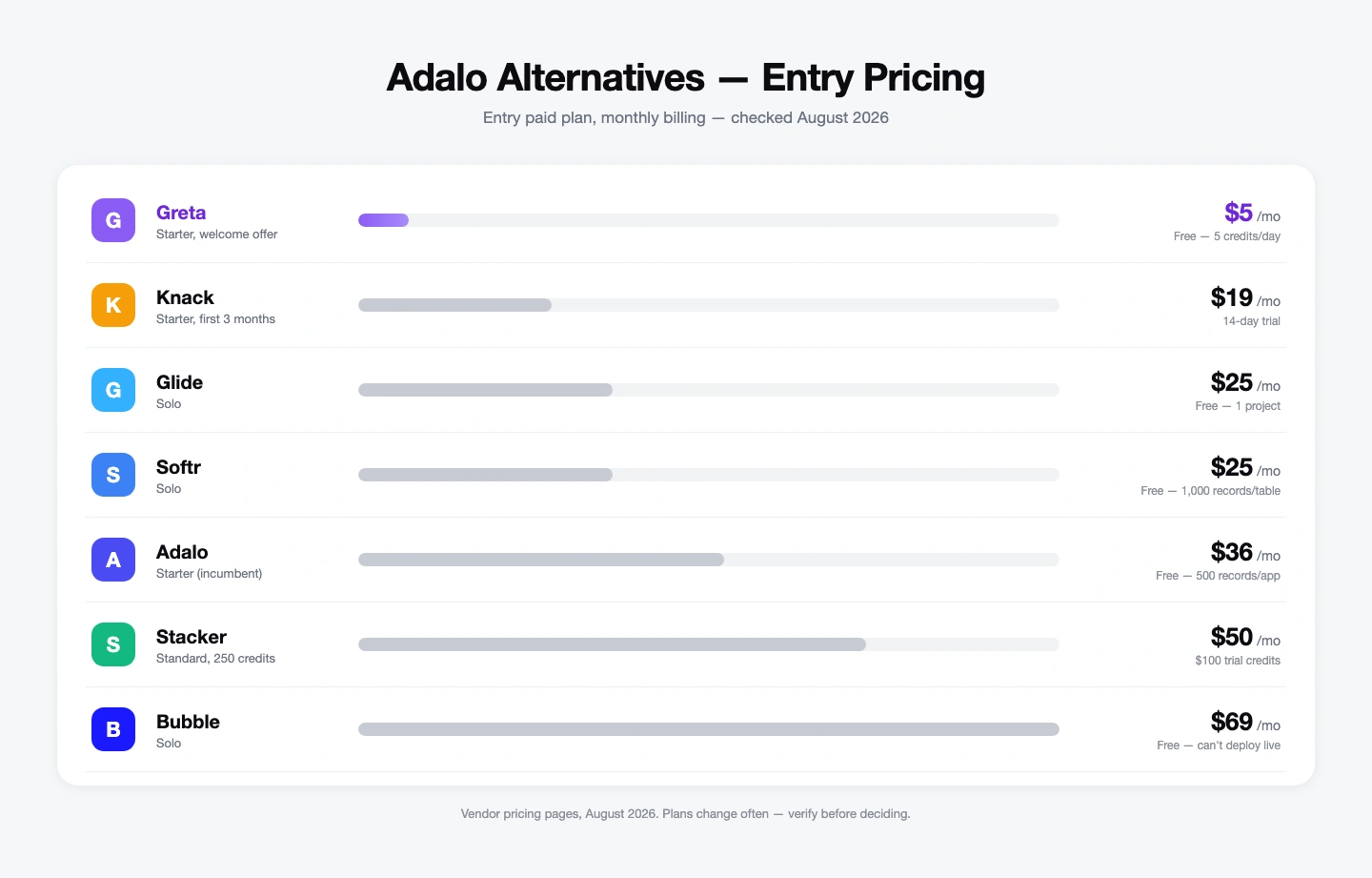
*Promotional welcome-offer pricing active as of August 2026 (standard list price in parentheses).
Why look for an Adalo alternative in the first place?
To be fair to Adalo: for a genuinely simple native-feeling mobile app - a booking tool, a community app, a simple marketplace - its no-code app builder is one of the more polished options available, and plenty of teams never outgrow it. The switch usually gets triggered by:
- Record and performance limits as the app's data grows past what its database tier comfortably holds.
- Logic you can't express in its workflow builder — multi-step conditional flows or anything needing real server-side code.
- Wanting the app to keep improving on its own — new features, pages, and SEO - without manually rebuilding it each time.
Does Adalo actually publish native apps, or is it a web app in a wrapper?
This is Adalo's real point of difference, and it's worth understanding before you compare anything else: paid Adalo plans include automated submission to the Apple App Store and Google Play, which most of the tools on this list either can't do at all or only do indirectly through a third-party wrapping service. Softr, Stacker, and Knack ship as web apps — installable as a PWA at best, but not a native store listing. Glide has leaned the same direction historically. If having your app discoverable and installable from an actual app store matters more to you than backend depth, that's a real reason to stay on Adalo rather than switch - see PWA vs. Native: What Should Vibe Coders Ship? for the fuller tradeoff between the two.
Adalo's flat-rate pricing vs. credit-based alternatives
Adalo prices flat by plan tier — no usage or token-based overage charges, so your bill doesn't move if usage spikes one month. That's a meaningfully different pricing shape from several tools on this list: Stacker, Knack's AI features, and Greta.sh all meter usage through a credit system, where a heavier month costs more. Flat pricing is easier to budget around; credit-based pricing usually gets you a lower entry price and scales with how much you actually build or run. Neither is "better" outright — it depends on whether your team wants predictability or wants to pay less while starting small.
Glide — best for fast, mobile-first internal apps
Glide turns a spreadsheet into a clean mobile app faster than almost anything else on this list, trading some of Adalo's native polish and app-store presence for build speed and a familiar Google Sheets/Airtable backend. Its Solo plan runs $25/month; the free plan caps you at one project with limited AI-agent credits for its Glide Agent feature.
Softr — best for web-first client portals
Softr leans web-first rather than mobile-first — client portals, directories, and marketplaces built on top of Airtable. Its free plan is generous for a spreadsheet-backed tool: 1,000 records per table, 5 collaborators, and a free custom domain. Softr restructured its pricing into Basic, Professional, and Business tiers during 2026, so confirm the current Basic-tier price directly before publishing.
Bubble — best for complex custom logic
Bubble is the most powerful classic no-code tool here — a real visual database, custom workflows, and enough flexibility for genuinely complex apps, at the cost of the steepest learning curve on this list. Its pricing has moved to a workload-unit model; expect a Starter (Web) tier in the neighborhood of $69/month as of mid-2026. The free plan includes 50,000 workload units but can't deploy a live, public app.
Stacker — best for internal tools with granular permissions
Stacker layers client portals and internal tools on Airtable, Google Sheets, or Salesforce with finer-grained permission controls than Adalo offers out of the box — useful if different users need to see different slices of the same data. It doesn't offer a recurring free plan, but new accounts get $100 in one-time credits that don't expire; the Standard plan runs $50/month for 250 credits.
Knack — best standalone database-app builder
Knack skips the "app on a simple database" model entirely and gives you a full relational database from the start, while staying no-code — a middle ground between Adalo's simplicity and Bubble's complexity. The Starter plan runs $59/month standard, discounted to $19/month for the first three months; there's no permanent free tier, only a 14-day trial with no card required.
Greta.sh — best for graduating off Adalo's model entirely
Greta.sh builds a full-stack app — UI, backend, real database, auth, and deployment — from a plain-English description, and keeps growing it after launch with built-in SEO/AEO instead of leaving it static once it ships. It's the pick once the app needs more than Adalo's database tier can comfortably hold, or once "an app that keeps improving itself" matters more than "an app I built once." The free plan includes 5 credits a day, a code viewer, and access to 3 design systems; the Starter plan is $5/month at the current welcome-offer price ($20/month standard), with a Pro tier at $20/month promotional ($50/month standard) for teams that need more room.
What happens if you outgrow Adalo — can you take your app with you?
This is a different lock-in shape than Glide or Softr. Because those tools sit on top of a spreadsheet or Airtable base you own, you can walk away and keep your underlying data usable elsewhere. Adalo's database is Adalo's own — there's no direct code export, so leaving means exporting your records and rebuilding the app's structure and logic somewhere else, not migrating a file. That's not a reason to avoid Adalo up front, but it's worth knowing before real customer data has been living in it for a year. This vendor lock-in and data ownership checklist walks through what to check before committing to any platform on this list.
How to choose the right Adalo alternative
- Need the app discoverable in the App Store or Google Play, and native polish matters more than backend depth → stay on Adalo.
- Want more build speed, less native polish, comfortable staying on a spreadsheet → Glide.
- Want a web-first client portal instead of a mobile app → Softr.
- Need real custom logic, comfortable with a learning curve (or a no-code dev) → Bubble.
- Need finer permission control on top of a spreadsheet → Stacker.
- Want a real database without leaving no-code → Knack.
- Have outgrown the model entirely, or want the app to keep growing itself post-launch → Greta.sh.
Why Greta.sh stands out as an Adalo alternative
Every other tool on this list, Adalo included, hands you a finished app and stops there — the next feature, page, or SEO improvement is on you to build manually. Greta.sh is built from a plain-English description and keeps improving the app on its own after launch, which matters most for teams who felt Adalo's real limitation wasn't the editor, but the ceiling underneath it - record limits, a database you can't take with you, and workflow logic the visual builder can't express. To be fair to Adalo: if the app really is a simple, native-feeling mobile app and will stay that size, its focus is a feature, not a gap.
A good example is one builder who used Greta.sh to launch the MVP of a payment processor, music distribution platform, and direct-to-fan storefront in just 21 weeks. Instead of managing multiple disconnected systems, Greta.sh let them build the entire platform around a single data layer and custom business logic.
Frequently asked questions about Adalo alternatives
Is there a free Adalo alternative?
Yes — Glide, Softr, and Greta.sh all have a genuinely usable free tier to start building on. Bubble's free tier only supports in-progress projects, not ones you can actually launch. Stacker and Knack don't offer a permanent free tier at all — Stacker gives new accounts $100 in one-time credits, and Knack offers only a 14-day free trial before their paid plans kick in.
What's the closest alternative to Adalo?
Glide is the closest in spirit — both lean heavily into mobile-first, no-code app building — though Glide is spreadsheet-backed while Adalo uses its own database, so the fit depends on how much data structure you actually need.
Does Adalo publish real apps to the App Store and Google Play?
Yes — Adalo's paid plans include automated distribution to the Apple App Store and Google Play, which is a real point of difference from spreadsheet-backed tools like Glide or Softr that mostly ship as installable web apps rather than native store listings. If app-store discoverability matters more to you than backend flexibility, that's a reason to stay on Adalo rather than switch.
Is Adalo's Ada AI assistant the same as an AI app builder like Greta.sh?
No — Ada assists inside Adalo's existing visual editor, suggesting components and speeding up edits, but you're still assembling the app on Adalo's own database model. An AI app builder like Greta.sh generates the entire app, including a real backend, from a plain-English description, rather than assisting inside a pre-built editor.
Is Adalo a good fit for internal tools, or is it built for customer-facing apps?
Adalo is optimized for shipping a polished, customer-facing mobile app — its pricing and app-store distribution features reflect that. For internal tools specifically — admin views, approval workflows, staff-only dashboards — a tool built around permissions and multi-user editing, like Stacker, Knack, or Greta.sh, is usually a better fit than paying for app-store distribution you won't use. Greta.sh's guide to role-based access covers the permission patterns worth having regardless of which tool you pick.
Can I export my data if I decide to leave Adalo?
You can export your records, but not the app itself — Adalo's database is proprietary, so leaving means rebuilding the app's structure and logic elsewhere and re-importing your data. That's different from spreadsheet-backed tools like Glide or Softr, where your Airtable or Google Sheets base stays usable independently of the no-code layer on top of it.
What should I use instead of Adalo if I've outgrown its database limits?
If the real problem is record limits or a lack of relational depth rather than Adalo's editor itself, the fix is a tool built around a full relational database — Knack for a no-code option, or Greta.sh if you also want the app to keep evolving without manual rebuilds.
Can AI build a native-feeling app the way Adalo does, but with a real backend?
Yes — Greta.sh builds a complete app (frontend, backend, database, and auth) from a plain-English description, rather than a UI layer on a simplified database, and continues improving the app after launch.
Explore more
See the full list of Greta.sh alternatives comparisons, compare Greta.sh vs Bubble directly, or check current Greta.sh pricing.
Last updated: August 12, 2026.